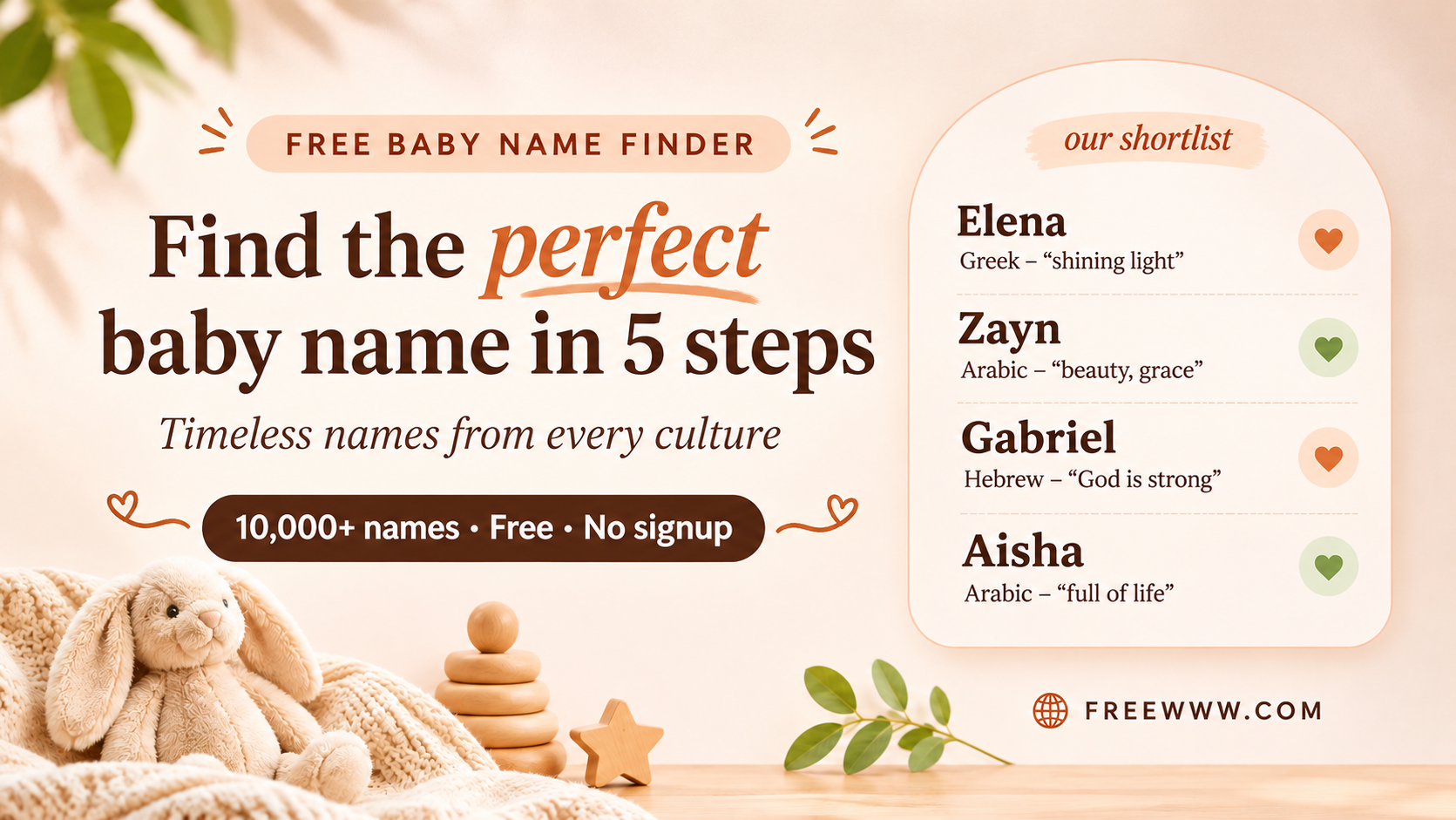
Baby Name Finder: How to Choose the Perfect Baby Name in 5 Steps (2026 Guide)
The easiest way to choose a baby name is to agree on a few must-haves with your partner, use a baby name finder to filter thousands of names down to a long list, then test your favorites out loud before deciding. Most parents who follow that order reach a shortlist they both love in days, not months.
This guide covers how a baby name finder works, a simple 5-step method, how to honor family and heritage, the latest popularity data, and the mistakes to avoid. You can follow along with the free FreeWWW Baby Name Finder, which searches 10,000+ names with no signup.
[IMAGE: Screenshot of the FreeWWW Baby Name Finder with origin, gender and length filters applied | alt: "Free baby name finder showing filters for origin, gender, name length and starting letter"]
What is a baby name finder?
A baby name finder is an online tool that searches a database of names using filters such as gender, origin, meaning, starting letter and length. Instead of scrolling a long list, you tell the tool what you want and it shows only the names that match.
That matters more than ever, because parents now choose from a far wider range of names. Fifty years ago, the 10 most common US names went to 25.6% of baby boys and 16.5% of baby girls. In 2025, the top 10 accounted for just 7.4% of boys and 6.4% of girls (AARP, citing Social Security data).
The FreeWWW Baby Name Finder searches more than 10,000 names from cultures around the world. You can filter by gender (boy, girl or unisex), origin, starting letter and name length, search by meaning, find matching sibling names, save favorites and copy your shortlist. It runs in your browser and needs no account.
When should you start choosing a baby name?
Most parents start talking about names in the second trimester and settle on a shortlist by the third. That leaves weeks to test names without the pressure of a newborn and a hospital form in front of you. Build your long list around weeks 20–28, cut it to five by week 34, and pick a front-runner and a backup before the birth. If you're short on time, the same steps work in one focused weekend.
How do you choose a baby name in 5 steps?
Work through these five steps in order. Each one removes names that won't work, so by the end you're choosing between a few strong options instead of thousands.
Step 1: Agree on ground rules and must-haves
Before either of you suggests a name, agree on how you'll decide. Does each partner get a veto? Will you ask family for input? Will you keep the name private until the birth? Couples who skip this step often argue for months over names one partner was never going to accept.
Then agree on two or three must-haves, such as a particular culture or language, a meaning (light, strength, peace), a length that suits your surname, or a name that's easy to say in both families' languages. These become your filters in Step 2.
Step 2: Build a long list with a baby name finder
Turn your must-haves into filters. In the FreeWWW finder, choose an Origin/Culture, a Gender (All, Boy, Girl or Unisex) and a Name Length: short (3–4 letters), medium (5–6) or long (7+).
The length filter is one most parents overlook. As a rule of thumb, pair a long surname with a short first name, and a short surname with a longer first name. "Ava Spencer " flows better than "Anastasia Cole"
Tap the heart on anything either of you likes, and aim for 20–30 names. If you get stuck, the Surprise Me button pulls a random name to spark new ideas.
Step 3: Search by meaning and origin
Use Search Meanings to find names linked to a word rather than a spelling. Type "light," "brave," or "gift," and the tool returns names from many origins that carry that meaning.
This is especially useful for families with two cultures. A search for "light" might surface Elena (Greek), Noor (Arabic) and Lucy (Latin) side by side, so each side of the family hears a name that makes sense to them. [ADD: one real example from your own users or family.]
Always check each name in every language your family speaks. A name that sounds lovely in one language can mean something unfortunate in another.
Step 4: Say it out loud and test the fit
Say every finalist with your surname at least ten times, including the way a teacher would call it across a classroom. Then check five things:
1. Flow: Does the first name blur into the surname?
2. Initials: Do the initials spell anything awkward?
3. Nicknames: Can you live with every likely short form?
4. Spelling: Will people spell it correctly after hearing it once?
5. Siblings: Does it sit well beside an older child's name? The finder's sibling-match feature can help.
Cut any name that fails more than one check. You should be down to five or fewer.
Step 5: Test-drive your favorites and decide
Open Show Favorites, then use Copy Shortlist to send your final names to your partner. Each of you ranks them privately from 1 to 5, and the names you both place in your top three are your finalists.
Now live with them. Call the bump by name A for a week, then name B for a week. Notice which one you reach for without thinking, and which you'd be sad to lose. Keep the runner-up as a backup in case your first choice doesn't fit the baby you meet.
How do you choose a name that honors family and heritage?
You can honor family by reusing a relative's name, adapting it into a modern form, using it as a middle name, or choosing a name with the same meaning in another language.
For bilingual families, the best names are easy to say and spell in every language you speak. Short names with simple sounds, like Adam, Sara, Noah, Lina, Maya and Rayan, travel well across cultures. If one language uses a non-Latin script, such as Arabic or Bengali, choose one English spelling early and use it on every document.
Many loved names are also shared across faiths, with different forms in different languages: Yusuf and Joseph, Maryam and Mary, Ibrahim and Abraham, Musa and Moses, and Dawud and David. These can be a good fit for interfaith families or for parents who want a name familiar to people from many backgrounds.
What are the most popular baby names right now?
Olivia and Liam were the most popular US baby names in 2025, holding the top spot for the seventh year in a row, according to the Social Security Administration.
Top 10 girls' names (2025): Olivia, Charlotte, Emma, Amelia, Sophia, Mia, Isabella, Evelyn, Sofia, Eliana.
Top 10 boys' names (2025): Liam, Noah, Oliver, Theodore, Henry, James, Elijah, Mateo, William, Lucas.
Charlotte moved up to No. 2 for girls, and Eliana entered the girls' top 10 for the first time. In 2026, search data reported by FOX 5 New York shows growing interest in double-barreled names, alternative spellings and names chosen for their meaning.
Use popularity as a tiebreaker, not a rule. Because names are so spread out today, even a top-10 name is shared by far fewer children than it would have been a generation ago.
What are the most common baby naming mistakes?
The most common mistake is choosing a name without testing it out loud with the full surname. Watch out for these too:
• Ruling out a name just because it's popular. Even top-10 names are shared by relatively few children today.
• Unusual spelling for its own sake. It leads to lifelong corrections. Choose a rare name, not a rare spelling.
• Ignoring meaning in another language. Search the meaning, then ask a native speaker.
• Forgetting initials and nicknames. Teasing often starts there.
• Announcing too early. Relatives' opinions get louder once a name is shared.
• Talking yourself out of a name you love. Data and opinions matter, but a name you genuinely love is usually the right one.
How do you agree on a name with your partner?
Each partner writes 10 names privately, then you swap lists and cross off any you can't accept. Whatever survives is your starting point. If you're still stuck between two names, one partner picks the first name and the other picks the middle name. Browsing a baby name finder together also helps, because it turns "your names versus mine" into choosing from a shared list.
If family members have strong views, decide together how much input they'll get, and share your final choice as a decision rather than a question.
[INTERNAL LINK: "free online tools" → FreeWWW homepage] [INTERNAL LINK: "unisex baby names" → future blog post on unisex names] [INTERNAL LINK: "baby names by meaning" → future blog post on names by meaning]
Find your baby's name today
Choosing a baby name is much easier when you filter before you browse. Agree on your must-haves, build a long list with a baby name finder, check meanings, test every finalist out loud, and live with your top two before you decide.
Start now with the free FreeWWW Baby Name Finder: 10,000+ names, meaning search, sibling matching and a copyable shortlist, with no signup.
Frequently asked questions
What is the best free baby name finder?
The best free baby name finder lets you combine filters, shows each name's meaning and origin, and doesn't require an account. The FreeWWW Baby Name Finder offers all three, with 10,000+ names, meaning search, length filters and sibling matching.
How do I choose a baby name?
Agree on two or three must-haves with your partner, use a baby name finder to build a long list, then check meanings, say each name with your surname and test your top two for a week each. Keep a backup in case your first choice doesn't fit the baby you meet.
When should we start choosing a baby name?
Many parents start in the second trimester and decide by the third. That leaves time to test names for a few weeks before the birth, though the same steps also work in a single weekend.
Can I search baby names by meaning?
Yes. Type a word such as "light," "strong" or "gift" into the Search Meanings box, and the tool returns names from different origins that carry that meaning.
How do I find a name that matches my older child's name?
Use the sibling-match feature to see names that pair well with an existing name. Look for names with a similar style and length that don't rhyme.
What is the most popular baby name in 2025?
Olivia and Liam were the most popular US baby names of 2025, the seventh year in a row at No. 1, according to Social Security Administration data published in May 2026.
What if my partner and I can't agree on a name?
Try the swap-and-cross method: each of you writes 10 names, swaps lists and crosses off names you can't accept. If you're still stuck, one partner chooses the first name and the other chooses the middle name.
Is it a bad idea to use an unusual spelling?
Usually, yes. Unusual spellings of common names lead to constant corrections. If you want something distinctive, choose a rare name with a simple spelling instead.