
Coin Toss Probability: What Happens in 100 Flips?
Flip a coin once, and the answer is simple: heads or tails. Flip it 100 times, and things get a lot more interesting. Most people expect a neat 50–50 split. Most of the time, that is not what they get.
In this guide, you'll learn coin toss probability in plain English: what a fair coin really does, why streaks happen, and what to expect from 100 flips. Then you can test it yourself with the free FreeWWW Coin Flip Simulator. No account, no download, no limits.

Key Takeaways
• Every flip of a fair coin is 50/50, no matter what came before.
• In 100 flips, exactly 50 heads happens only about 8% of the time.
• About 73% of the time, you'll get between 45 and 55 heads.
• Streaks are normal. In 100 flips, a run of 6 or more of the same side shows up about 81% of the time.
• The more you flip, the closer the heads percentage gets to 50%.
What Is Coin Toss Probability?
Coin toss probability (also called coin flip probability) measures how likely each result is when you flip a coin. A coin has two possible outcomes: heads or tails. On a fair, unbiased coin, both outcomes are equally likely.
Each flip is an independent event. That means one flip has no effect on the next. The coin does not remember what it did last time.
The Coin Toss Probability Formula
The basic formula is simple:
Probability = favorable outcomes ÷ total possible outcomes
For one flip, the probability of heads is 1 ÷ 2 = 0.5, or 50%.
For several flips in a row, you multiply. The chance of two heads in a row is ½ × ½ = ¼, or 25%. The chance of three heads in a row is ½ × ½ × ½ = ⅛, or 12.5%.
Want to check the math? Multiply fractions with the free FreeWWW Fraction Calculator, then turn them into percentages with the FreeWWW Percentage Calculator.
Theoretical vs. Experimental Probability
Theoretical probability is what should happen. For a fair coin, that is 50% heads.
Experimental probability is what actually happens when you flip. If you get 54 heads in 100 flips, your experimental probability of heads is 54 ÷ 100 = 54%.
Both numbers matter. The OpenStax Statistics textbook explains the difference with simple coin examples.
What Happens When You Flip a Coin 100 Times?
Here is the one big surprise. The expected value is 50 heads. Yet you will get exactly 50 heads in only about 8% of 100-flip experiments. Around 92% of the time, you'll get something else.
Why? Mathematicians use the binomial distribution to count every possible way 100 flips can turn out. There are far more combinations that give 48, 51 or 53 heads than combinations that give exactly 50. When you chart all the results, they form a bell curve centered on 50.
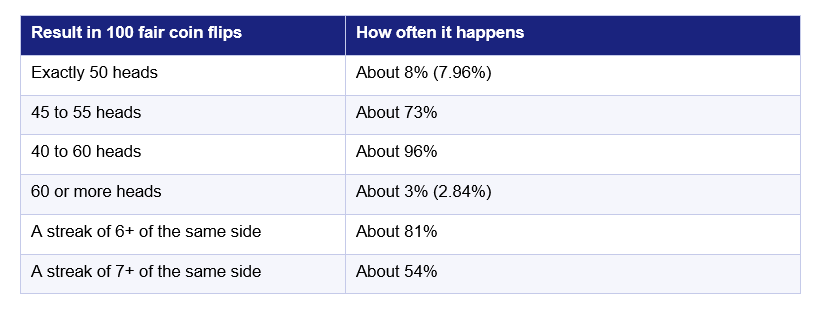
So if your 100 coin flips end at 53–47 or even 57–43, nothing is wrong. That is normal statistical variation.
Coin Flip Odds: How Likely Are Heads in a Row?
Streaks feel suspicious, but they are part of randomness. Here are the coin flip odds for consecutive heads, starting from any single flip:
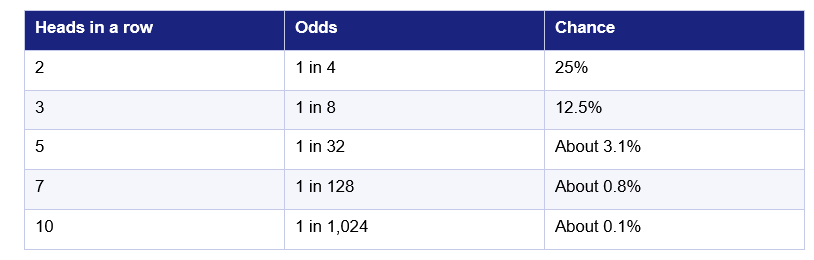
Ten heads in a row sounds almost impossible. But over a long session, you get many chances for a streak to start. In 100 flips, the longest streak of the same side is usually about 7 flips long.
The Gambler's Fallacy: Why Tails Is Never "Due"
After five heads in a row, many people feel that tails "has to" come next. It doesn't. The next flip is still 50/50.
This mistake is called the gambler's fallacy. Its most famous example happened at the Monte Carlo Casino in 1913. The roulette ball landed on black 26 times in a row, and gamblers lost millions betting that red was "due."
A coin has no memory and no plan to even things out. A streak tells you what already happened. It does not predict what comes next.
Is a Coin Flip Really 50/50?
In math class, a fair coin is perfectly 50/50. Real coins are almost the same, with one small twist.
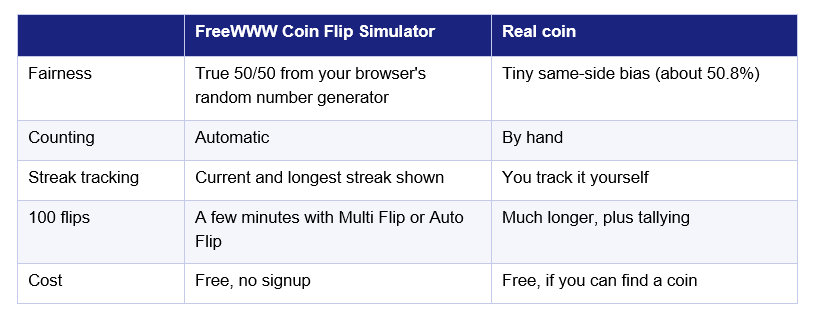
In a large study, researchers recorded 350,757 real coin flips. Heads and tails came up equally often overall. But coins landed on the same side they started on about 50.8% of the time. This tiny same-side bias comes from how people flip, not from the coin itself. Stanford statistician Persi Diaconis had predicted a similar effect back in 2007.
A virtual coin flip avoids this. The FreeWWW Coin Flip Simulator uses your browser's random number generator, so each result is a true 50/50 pick with no thumb, no wobble and no weighted coin.
The Law of Large Numbers: Why More Flips Get Closer to 50%
Small samples can look wild. Big samples settle down. This is the law of large numbers: as you flip more, the share of heads moves closer to 50%.
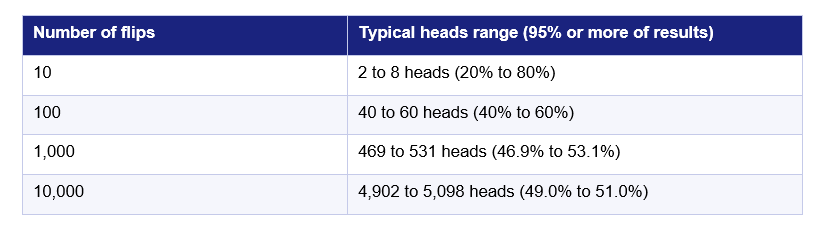
Here is a twist most people miss. The percentage gets closer to 50%, but the raw gap between heads and tails often gets bigger. On average, the gap is about 8 after 100 flips and about 80 after 10,000 flips. The SOCR law of large numbers activity lets you see this in action.
How to Flip a Coin 100 Times Online (Free, No Signup)
You don't need a coin, a notebook or a pencil. Use the FreeWWW Coin Flip Simulator and follow these steps:
1. Make a guess. Write down how many heads you think you'll get.
2. Open the simulator. It works in any modern browser, on phone or computer.
3. Choose a coin. Pick one from the Coin Type list of authentic coins from around the world.
4. Click Reset Stats. This starts your count at zero.
5. Flip fast. Click Multi Flip to flip several coins at once (5 by default; change the Multi Flip Count in Settings), or click Auto Flip and let it run.
6. Stop at 100. Check Total Flips, Heads, Tails, Heads %, Tails % and Longest Streak.
7. Repeat and compare. Click Reset Stats and run it again. Your two results will almost never match.
Key Features of the FreeWWW Coin Flip Simulator
• Three ways to flip: single Flip Coin, Multi Flip and Auto Flip.
• Live statistics: Total Flips, Heads, Tails, Heads %, Tails %, Current Streak and Longest Streak.
• Recent Flips history: see your latest results at a glance.
• Real coin designs: authentic coin images from around the world.
• Your settings: Slow, Normal or Fast animation, plus sound on or off.
• Totally free: no account, no credit card and no limits.
Online Coin Flip vs. Real Coin Toss
Who Can Use This 100-Flip Experiment?
Teachers and Students
It makes a simple, hands-on probability lesson. Ask each group to run 100 flips, then compare the results on the board. Together, the class results start to form a bell curve.
Parents and Kids
It's a quick math game for home. Kids guess, flip and check their predictions. They learn about fractions, percentages and chance without a worksheet.
Anyone Making a Quick Choice
A coin toss is a fair way to settle small choices, like who goes first. For more than two options, try the FreeWWW Spinner Wheel. For dice rolls and random numbers, use the FreeWWW Random Generator. Keep big choices about health, money or safety for careful thinking, not a coin.
Ready to Test Coin Toss Probability Yourself?
Make your guess. Then open the FreeWWW Coin Flip Simulator and flip 100 times. Watch the streaks grow and the percentages move. Then see how close you get to 50/50.
Looking for more free tools for math and learning? Read our guide to the FreeWWW Fraction Calculator, or browse every tool with the FreeWWW Discovery Tool.
Frequently Asked Questions
1. What is coin toss probability?
Answer: Coin toss probability is the chance of each result when you flip a coin. A fair, unbiased coin has two possible outcomes, so the theoretical probability of heads is 1 in 2 (50%), and tails is 50% too. The OpenStax Statistics textbook explains this with simple coin examples.
2. What is the coin flip probability formula?
Answer: Probability = favorable outcomes ÷ total possible outcomes. For one flip, heads = 1 ÷ 2 = 50%. Because flips are independent events, you multiply for flips in a row: two heads = ½ × ½ = 25%. At least one head in 3 flips = 1 − ⅛ = 87.5%. Check the fractions with the FreeWWW Fraction Calculator.
3. What is the probability of getting exactly 50 heads in 100 flips?
Answer: About 7.96%. The binomial distribution counts all the combinations for each result. Exactly 50 heads is the single most likely result, but nearby counts like 48 or 53 add up to far more. Charted together, they form a bell curve centered on 50.
4. How many heads should I expect in 100 coin flips?
Answer: The expected value is 50 heads. Because of normal statistical variation, about 73% of 100-flip experiments land between 45 and 55 heads. To find your experimental probability, divide your heads by 100 or use the FreeWWW Percentage Calculator.
5. What are the odds of flipping heads twice in a row?
Answer: The coin flip odds of two consecutive heads are 1 in 4, or 25%. Each flip has a ½ probability of heads, and ½ × ½ = ¼. Three heads in a row is 1 in 8 (12.5%). For more help with fractions like these, read our Fraction Calculator guide.
6. What are the coin flip odds of getting 10 heads in a row?
Answer: The odds are 1 in 1,024, or about 0.1%, from any single starting flip. Over a long session, randomness makes streaks much more common. Run 100 flips in the FreeWWW Coin Flip Simulator and watch the Longest Streak counter. It usually reaches about 7.
7. Is a coin flip really 50/50?
Answer: A fair coin is 50/50 in theory. In a study of 350,757 real coin flips, coins landed on the same side they started about 50.8% of the time. This small same-side bias comes from the flipper, not a weighted coin. An online flip that uses a random number generator gives a true 50/50 result.
8. Does the last flip change the next one?
Answer: No. Coin flips are independent events, so coin toss probability stays 50/50 on every flip. Believing tails is "due" after a run of heads is called the gambler's fallacy. A coin has no memory.
9. What is the law of large numbers in coin tossing?
Answer: The law of large numbers says that as you flip more, your experimental probability moves closer to the theoretical probability of 50%. After 10,000 flips, heads lands between 49% and 51% about 95% of the time. Try the SOCR coin toss experiment to see it happen.
10. How can I test coin toss probability online for free?
Answer: Open the FreeWWW Coin Flip Simulator, click Reset Stats, then use Multi Flip or Auto Flip until Total Flips reaches 100. It's free, with no signup. For dice and random numbers, try the FreeWWW Random Generator.