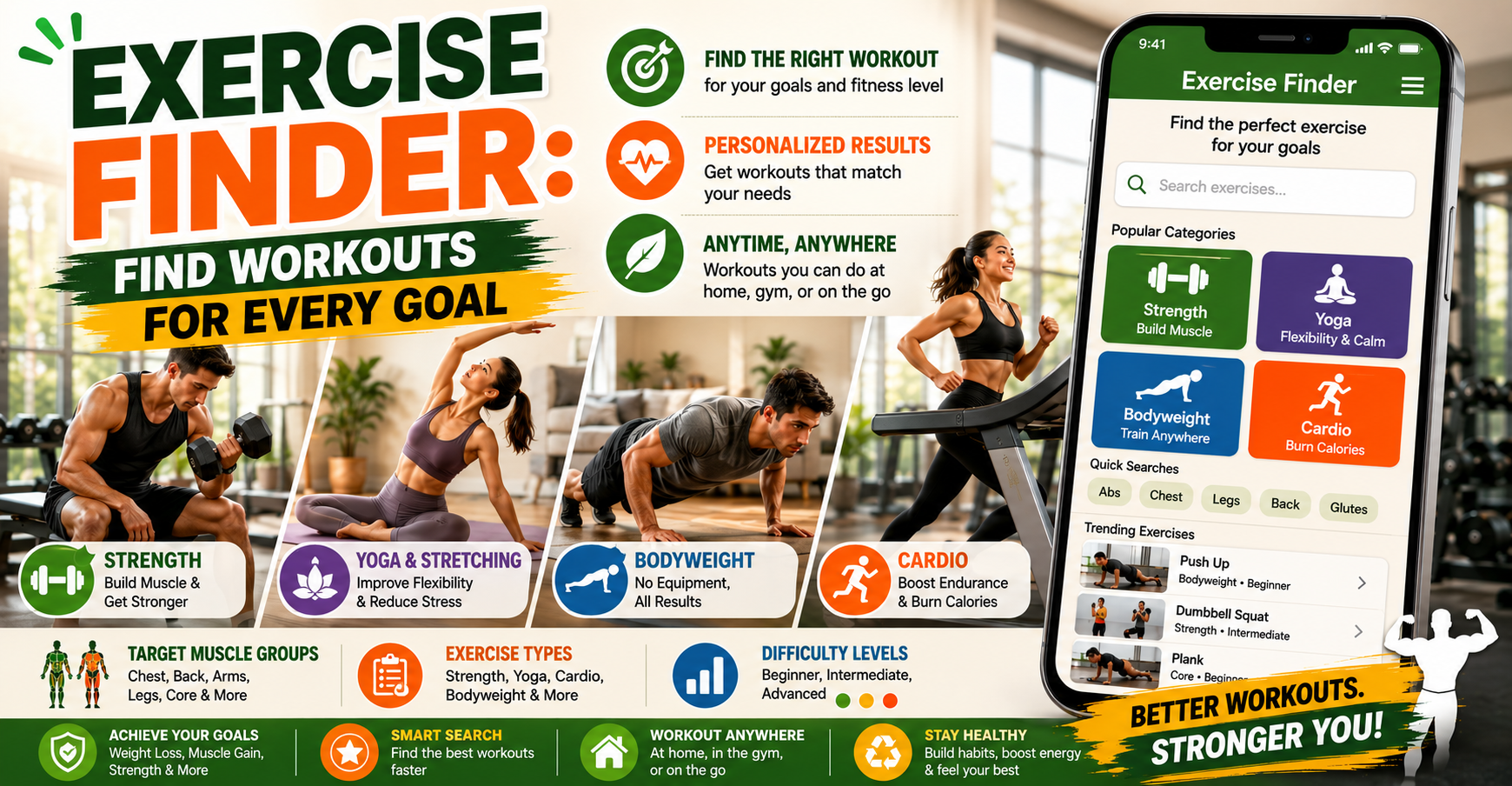
Find Exercises Easily with the Free Exercise Finder
The Exercise Finder is a free tool helping users find exercises for their goals, muscle groups, or fitness levels. Whether building strength, improving cardio, or enhancing flexibility, it provides detailed guidance for safe workouts.
Why an Exercise Finder Matters
Fitness success depends on performing the right exercises for your goals. Beginners often struggle to identify which exercises target specific muscles, while seasoned athletes may need new variations to prevent plateaus. The Exercise Finder solves these problems by organizing exercises by type, muscle group, and difficulty level.
- Targeted Workouts: Focus on specific muscles or joints.
- Balanced Training: Ensure all major muscle groups are exercised.
- Safety: Proper guidance reduces the risk of injury.
Features of the Exercise Finder
1. Muscle Group Categorization
Users can focus on specific muscles:
- Arms: biceps, triceps, forearms
- Legs: quads, hamstrings, glutes, calves
- Core: abs, obliques, lower back
- Full Body: compound movements like squats, push-ups, and deadlifts
This helps create focused routines that align with personal goals.
2. Exercise Type Filters
Filter exercises by type:
- Strength Training: Weights, resistance bands, bodyweight exercises
- Cardio: Running, cycling, jump rope, HIIT
- Flexibility: Stretching, yoga, mobility drills
- Balance & Stability: Core stability, single-leg exercises
3. Difficulty Levels
Exercises are categorized for beginners, intermediates, and advanced users. This ensures routines are challenging but safe.
4. Detailed Instructions
Each exercise entry includes:
- Step-by-step execution
- Recommended sets and repetitions
- Safety tips and common mistakes
- Targeted muscles
- Equipment needed
How to Use the Exercise Finder Effectively
Step 1: Identify Your Goal
Decide whether your primary goal is strength, cardio, flexibility, or balance. This helps narrow down exercise options quickly.
Step 2: Choose Targeted Muscle Groups
If your goal is strength or hypertrophy, select the muscles you want to focus on. For cardio, select movement types or intensity levels.
Step 3: Filter by Difficulty
Choose a difficulty level based on your fitness experience. Beginners should focus on low-impact, simple movements, while advanced users can explore complex variations.
Step 4: Review Instructions
Carefully read step-by-step instructions, noting posture, range of motion, and equipment. Following the guidelines prevents injury and maximizes effectiveness.
Step 5: Build a Routine
Combine exercises into a workout plan. The Exercise Finder helps balance muscle groups and workout types for comprehensive fitness routines.
Benefits for Different Users
Beginners
Provides clear, guided instructions and beginner-friendly exercises. Reduces confusion and builds confidence.
Home Workout Enthusiasts
Offers exercises requiring minimal equipment, ideal for small spaces or bodyweight-only routines.
Gym Users
Suggests weight-based and machine exercises with proper form and tips.
Personal Trainers
Helps build client-specific routines quickly and efficiently.
Rehabilitation & Physical Therapy
Includes low-impact and controlled exercises suitable for recovery or injury prevention.
Exercise Categories in Detail
Strength Training
Strength exercises build muscle mass, improve bone density, and enhance metabolism. Examples:
- Squats and lunges for lower body
- Push-ups and bench press for upper body
- Deadlifts and kettlebell swings for full-body engagement
Tip: Always start with proper form and moderate weight.
Cardio
Cardiovascular exercises improve heart health, endurance, and calorie burn. Examples:
- Running, cycling, rowing
- Jump rope or HIIT sessions
- Swimming and elliptical workouts
Tip: Vary intensity and duration to prevent overuse injuries.
Flexibility & Mobility
Flexibility exercises prevent injuries, reduce stiffness, and enhance movement. Examples:
- Yoga flows and stretches
- Dynamic warm-ups for joints
- Foam rolling for recovery
Balance & Core
Core stability and balance exercises improve posture, reduce injury risk, and enhance athletic performance. Examples:
- Planks, side planks, and bird dogs
- Single-leg squats and stability ball exercises
- Balance board or bosu ball workouts
Creating Personalized Workouts with the Exercise Finder
- Full-Body Routine: Combine exercises from each category for balanced fitness.
- Targeted Routine: Focus on specific goals, like glute development or upper-body strength.
- Home Routine: Select exercises requiring minimal equipment.
- Gym Routine: Include machines, free weights, and advanced variations.
Tip: Adjust sets, reps, and rest periods according to fitness level and goals.
Tracking Progress
Use the Exercise Finder alongside fitness trackers, journals, or apps. Note:
- Weights used
- Number of repetitions and sets
- Rest periods
- Exercise modifications
Tracking progress ensures continuous improvement and motivates adherence.
Safety and Best Practices
- Warm-up and cool-down properly to reduce injury risk.
- Maintain proper form; use mirrors or guidance when needed.
- Start with moderate intensity and gradually progress.
- Listen to your body; avoid overtraining or pain-inducing exercises.Common Mistakes and How to Avoid Them
- Skipping warm-ups or stretching
- Using improper form
- Ignoring rest periods
- Overestimating capacity or weight
- Neglecting balanced training (e.g., focusing only on one muscle group)
The Exercise Finder reduces these mistakes by providing clear, structured instructions.
Conclusion
The Exercise Finder is a versatile, free tool that helps everyone from beginners to advanced athletes find the right exercises for their goals. By offering targeted, detailed guidance and customizable routines, it promotes safer, more effective workouts.
Start using the Exercise Finder today to create personalized, safe, and effective workouts at home or in the gym!
FAQs
What is the Exercise Finder?
Ans: The Exercise Finder is a free online tool that helps users discover exercises for specific muscles, goals, or fitness levels.
Who can use the Exercise Finder?
Ans: Anyone from beginners to personal trainers can use it to find exercises suitable for their fitness level or goals.
Does it include strength training exercises?
Ans: Yes, including free weights, bodyweight, and machine exercises targeting all major muscle groups.
Can I find cardio exercises?
Ans: Yes, it provides options like running, cycling, HIIT, and other aerobic exercises, with guidance similar to Mayo Clinic Exercise Tips.
Does it include flexibility and mobility exercises?
Ans: Yes, including stretches, yoga poses, and joint mobility drills for all fitness levels.
Can I find balance and core exercises?
Ans: Yes, exercises such as planks, single-leg squats, and stability ball routines are included.
Is the Exercise Finder suitable for home workouts?
Ans: Yes, it provides exercises that require minimal equipment, ideal for small spaces.
Does it provide difficulty levels?
Ans: Yes, exercises are categorized for beginners, intermediate, and advanced users.
Can I build a personalized routine with the Exercise Finder?
Ans: Absolutely, the tool allows combining exercises by goal, muscle, and type to create customized routines.
Is the Exercise Finder free to use?
Ans: Yes, it is completely free and accessible on both desktop and mobile devices. Users can also refer to American Council on Exercise for additional exercise resources.