How Can a Due Date Calculator Help Track Pregnancy?

After a positive pregnancy test, one of the first questions many expecting parents ask is: “When is my baby likely to arrive?” A Due Date Calculator provides an estimated delivery date based on pregnancy timing information, helping families understand their current pregnancy stage and prepare for upcoming milestones. It can be useful for planning, but it should be treated as a timeline estimate rather than a prediction of the exact day labor will begin.

Want a quick estimate? Use the FreeWWW Pregnancy Due Date Calculator and then discuss important pregnancy dates with your healthcare professional.
What Is a Due Date Calculator?
A due date calculator is an online tool that estimates a baby’s expected delivery date from pregnancy timing information. Most calculators use the first day of the last menstrual period (LMP) because the exact date of conception is often unknown. The result is usually called the estimated due date, or EDD.
The calculation is commonly based on a 40-week pregnancy timeline measured from the first day of the LMP. This convention assumes a 28-day menstrual cycle with ovulation around day 14, so irregular cycles or uncertain dates can reduce the accuracy of an LMP-only estimate.
What Information Do You Need Before Using a Due Date Calculator?
Most users only need a few pieces of information:
- The first day of the last menstrual period (LMP)
- Average menstrual cycle length, if the calculator allows an adjustment
- Conception or fertility-treatment dates, when known and supported by the calculator
- Any updated pregnancy dating information provided by a healthcare professional
If the LMP date is unknown or the cycle is highly irregular, the online estimate may be less reliable. In that situation, a clinician can use ultrasound and medical history to establish a more appropriate pregnancy timeline.
How Does a Pregnancy Due Date Calculator Work?

- Enter the first day of your last menstrual period.
- Add your typical menstrual cycle length if the tool supports it.
- The calculator estimates 40 weeks from the LMP-based starting point.
- Review the estimated due date and current pregnancy stage.
- Use the result for planning, then confirm important dates during prenatal care.
Example: Calculating a Due Date From the Last Period
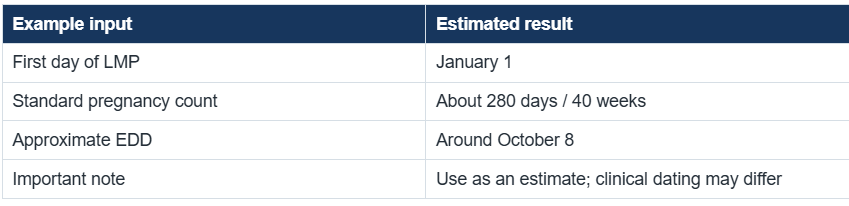
Imagine the first day of the last menstrual period was January 1. A standard LMP-based calculation adds approximately 280 days, giving an estimated due date around October 8. This is an educational example; the estimate can change if cycle length differs from 28 days or if ultrasound dating provides a more accurate timeline.
How Accurate Is a Due Date Calculator?
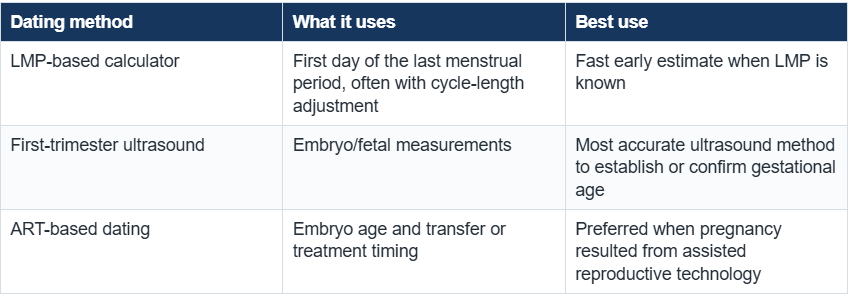
A due date calculator is useful for estimating pregnancy timing, but it cannot predict the exact day of birth. LMP-based calculations work best when the first day of the last period is known and menstrual cycles are reasonably regular. ACOG notes that the traditional 280-day method assumes a 28 day cycle with ovulation around day 14, so variations in cycle length and ovulation can affect the estimate.
Ultrasound can improve pregnancy dating. ACOG identifies first-trimester ultrasound, through 13 weeks and 6 days, as the most accurate ultrasound method to establish or confirm gestational age. The NHS also advises that a dating scan can provide a more accurate estimate of how many weeks pregnant someone is.
When Can a Calculator Estimate Be Less Reliable?
- The LMP date is uncertain or difficult to remember.
- Menstrual cycles are irregular or significantly different from 28 days.
- Ovulation occurred earlier or later than the standard assumption.
- The pregnancy resulted from assisted reproductive technology (ART), where treatment dates are more appropriate for dating.
- Ultrasound findings indicate a different gestational age.
Due Date by LMP vs. Ultrasound Dating
Due Date Calculator vs. Pregnancy Week Calculator
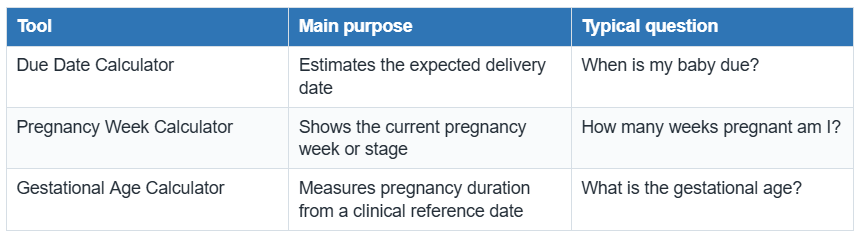
These tools answer related but different pregnancy-timing questions:
How a Due Date Estimate Helps With Pregnancy Planning
Track pregnancy progress
An EDD provides a reference point for understanding approximately how far the pregnancy has progressed.
Prepare for prenatal appointments
Healthcare visits, screening discussions, and pregnancy education are often organized around gestational age.
Plan practical arrangements
Families may use the estimated timeline to think about work, transportation, baby supplies, support, and hospital preparation.
Understand milestones
A timeline can make it easier to follow week-by-week educational information while remembering that individual pregnancies vary.
Common Due Date Calculator Mistakes to Avoid
- Entering the last day of the period instead of the first day of the LMP.
- Assuming every menstrual cycle is exactly 28 days.
- Treating the estimated due date as a guaranteed birth date.
- Ignoring updated dating information from an ultrasound or clinician.
- Using a calculator as a replacement for prenatal care.
Open the FreeWWW Pregnancy Due Date Calculator
Why Pregnancy Dating Matters in Prenatal Care
Accurate pregnancy dating helps clinicians interpret fetal growth, schedule appropriate prenatal tests, and make time-sensitive care decisions. ACOG emphasizes that the gestational age and EDD should be determined and documented once reliable LMP and/or ultrasound information is available, with later changes reserved for specific clinical circumstances.
This is why an online calculator is best viewed as an accessible first estimate. The clinical pregnancy record, including ultrasound findings and medical history, remains the appropriate source for individualized care decisions.
Conclusion
A due date calculator helps expecting parents understand where they may be in the pregnancy journey, from early planning to upcoming appointments and milestones. By using the first day of the last menstrual period and, when available, cycle-length information, the calculator provides a useful estimated delivery date.
The result should be viewed as an estimated timeline rather than a guaranteed birth date. Irregular cycles, uncertain dates, fertility treatment, and ultrasound findings can change pregnancy dating. For the most accurate guidance, combine calculator results with regular prenatal care and the pregnancy dates documented by your healthcare professional.
Frequently Asked Questions
1. What is a Due Date Calculator?
Answer: A Due Date Calculator is an online tool that estimates an expected delivery date (EDD), usually from the first day of the last menstrual period and sometimes from cycle length or other pregnancy timing information.
2. How do I calculate my due date from my last period?
Answer: A common method counts approximately 280 days, or 40 weeks, from the first day of the last menstrual period. This assumes a standard cycle and provides an estimate rather than an exact birth date.
3. How accurate is a pregnancy due date calculator?
Answer: It can provide a useful estimate when the LMP is known and cycles are regular, but it cannot predict the exact day of birth. First-trimester ultrasound is more accurate for establishing or confirming gestational age when clinical dating is needed. ACOG guidance on estimating the due date
4. What information do I need to use a pregnancy due date calculator?
Answer: Most calculators ask for the first day of the last menstrual period. Some also allow menstrual cycle length, conception date, or fertility-treatment information.
5. Can my due date change during pregnancy?
Answer: Yes. A healthcare professional may revise the EDD when reliable ultrasound findings or other clinical information indicate a different gestational age. Once an appropriate EDD is established, later changes are generally limited to specific circumstances.
6. Can I use a due date calculator if my periods are irregular?
Answer: You can get an estimate, but LMP-based dating may be less precise when cycles are irregular or the LMP is uncertain. A dating ultrasound and clinical assessment can provide more reliable information.
7. Is a due date the exact day my baby will be born?
Answer: No. The due date is an estimate used to organize pregnancy timing. Normal pregnancy length varies, so labor may begin before or after the estimated date.
8. What is gestational age?
Answer: Gestational age describes how far a pregnancy has progressed and is usually counted from the first day of the last menstrual period. It is commonly expressed in completed weeks and days.
9. Does an ultrasound give a more accurate due date?
Answer: Early ultrasound can establish or confirm gestational age more accurately than a later ultrasound. ACOG identifies first-trimester ultrasound as the most accurate ultrasound method for pregnancy dating.
10. Where can I find reliable guidance about pregnancy dating?
Answer: Use trusted medical sources and your own prenatal care team. The NHS provides a public due date calculator and explains how LMP and dating scans are used. NHS pregnancy due date calculator