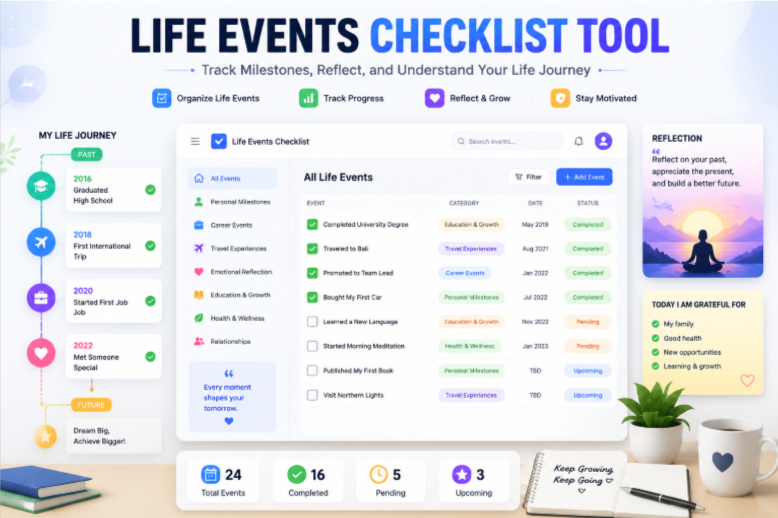
Life Events Checklist Tool for Tracking and Understanding Your Life Journey
What is a Life Events Checklist Tool?
A life events checklist tool is a structured digital system designed to help people record, organize, and reflect on meaningful moments throughout their lives. Unlike casual note-taking or freeform journaling, it gives shape to life experiences by turning them into trackable milestones.
The Life Events Checklist Tool available on FreeWWW is designed for this purpose, allowing users to document important events in a clean, structured checklist format without complexity.
At its core, the tool is not just about recording what happened. It is about helping users understand patterns in their life, recognize progress, and create clarity from memory.
Why structuring life events actually matters
Most people go through thousands of moments in life, but only a few are ever remembered clearly. Over time, these moments become fragmented memories instead of a clear story.
A life events checklist tool helps solve this problem by creating structure.
When life events are recorded consistently, three important things happen:
First, memory becomes more reliable. Instead of relying on recall, users build a documented timeline of their experiences.
Second, emotional awareness improves. Seeing events written down helps identify what situations create stress, happiness, growth, or change.
Third, personal development becomes visible. Growth is often hard to notice in real time, but structured tracking reveals progress over months and years.
This is what makes tools like the Life Events Checklist Tool more than productivity utilities. They act as simple reflection systems that support long-term self-awareness.
How the Life Events Checklist Tool works in real use
The tool is designed to feel simple on the surface, but its value comes from how users interact with it over time.
When a user opens the Life Events Checklist Tool, they are essentially creating a personal timeline of meaningful experiences. Instead of writing long paragraphs, each life event is recorded as a structured entry.
Over time, this becomes a personal history system.
For example, a user might log:
- A graduation or academic milestone
- Starting a new job or career shift
- Moving to a new place
- A major travel experience
- A personal achievement or breakthrough
- A challenging life period or emotional change
Each entry becomes a reference point. When revisited later, these entries help users understand how their decisions and experiences shaped their current life situation.
This structured approach is especially helpful for people who struggle with traditional journaling because it reduces the pressure of writing and focuses instead on simple logging.
The real purpose behind life event tracking
The deeper value of a life events checklist tool is not organization alone. It is reflection.
Human memory tends to highlight emotional peaks while ignoring gradual change. This creates a distorted understanding of personal growth. By using a structured system, users can see both major milestones and subtle progress patterns.
For example, someone might feel like they have “not progressed” in life. But when they review their checklist over a year, they may notice job changes, skill development, emotional recovery, or lifestyle improvements they had forgotten.
This shift in perception is one of the most powerful benefits of structured life tracking.
It turns vague memory into a visible journey.
Who benefits most from this tool?
A life events checklist tool is useful across different types of users because it adapts to different goals.
Students often use it to track academic milestones, exam results, and transitions between education stages. This helps them understand long-term academic progress rather than focusing only on individual results.
Professionals use it to document career growth, promotions, job changes, and skill development. This makes performance reviews and career planning more structured.
Individuals focused on self-improvement use it as a reflection system to track habits, emotional patterns, and personal achievements.
Even coaches, therapists, and mentors can use structured life tracking as a support tool for guided reflection sessions.
The simplicity of the format is what makes it widely applicable. It does not require training or technical knowledge.
Limitations of checklist-based reflection
While the Life Events Checklist Tool is useful, it is not designed to replace deeper journaling or professional mental health tools.
Because it is structured, it does not capture long emotional narratives or complex thoughts in detail. It focuses more on “what happened” rather than “how it felt in depth.”
It also depends on user consistency. If entries are not updated regularly, the timeline becomes incomplete and less meaningful.
However, these limitations are not weaknesses in design. They reflect the purpose of the tool: fast, structured reflection instead of deep writing.
Many users combine checklist tracking with journaling for best results.
Why tools like this are becoming more relevant
Modern digital life is fragmented. People use multiple apps for tasks, memories, notes, and planning. In this environment, structured reflection tools are gaining importance because they simplify how personal history is stored.
Instead of scattered notes, users build a single timeline of meaningful life moments.
This aligns with a growing trend in digital wellbeing, where individuals seek clarity, reflection, and intentional living instead of constant digital noise.
The Life Events Checklist Tool fits into this shift by offering a simple, distraction-free way to track life events without complexity.
Conclusion
The life events checklist tool is a simple but powerful system for organizing personal milestones and reflecting on life experiences in a structured way. It helps users transform scattered memories into a clear timeline, making personal growth easier to understand and track.
It is not just a productivity tool. It is a personal reflection system that helps people see their life more clearly over time.
Start tracking your personal milestones with the Life Events Checklist Tool and build a clear, structured timeline of your life journey.
FAQs
1. What is a life events checklist tool?
It is a structured digital tool used to record and organize important personal milestones and life experiences in a simple checklist format.
2. How is it different from journaling?
Journaling focuses on detailed writing and emotions, while a checklist tool focuses on structured tracking of events and milestones.
3. What kind of life events should I track?
You can track career changes, education milestones, relationships, travel, achievements, and personal growth experiences.
4. Is this tool useful for mental wellbeing?
Yes, structured reflection can improve self-awareness and help users understand emotional patterns over time.
For deeper insights into reflective writing benefits, see: Positive Psychology
5. Can this tool improve personal development?
Yes, reviewing life events over time helps users identify growth, behavior patterns, and progress that may otherwise go unnoticed.
6. Is the Life Events Checklist Tool free?
Yes, it is a free browser-based tool with no installation required.
7. Do I need technical skills to use it?
No, it is designed for simple use without any technical or design knowledge.
8. How often should I update my life events?
Most users update it weekly, monthly, or after significant life events.
9. Can this replace therapy or counseling?
No. While it supports reflection, it is not a substitute for professional mental health support.
For mental health and self-reflection guidance, visit: American Psychological Association
10. Who should use this tool?
Anyone interested in self-awareness, personal growth, productivity, or structured life tracking can benefit from it.