Play Word Tetris Online for Fun Vocabulary Challenges
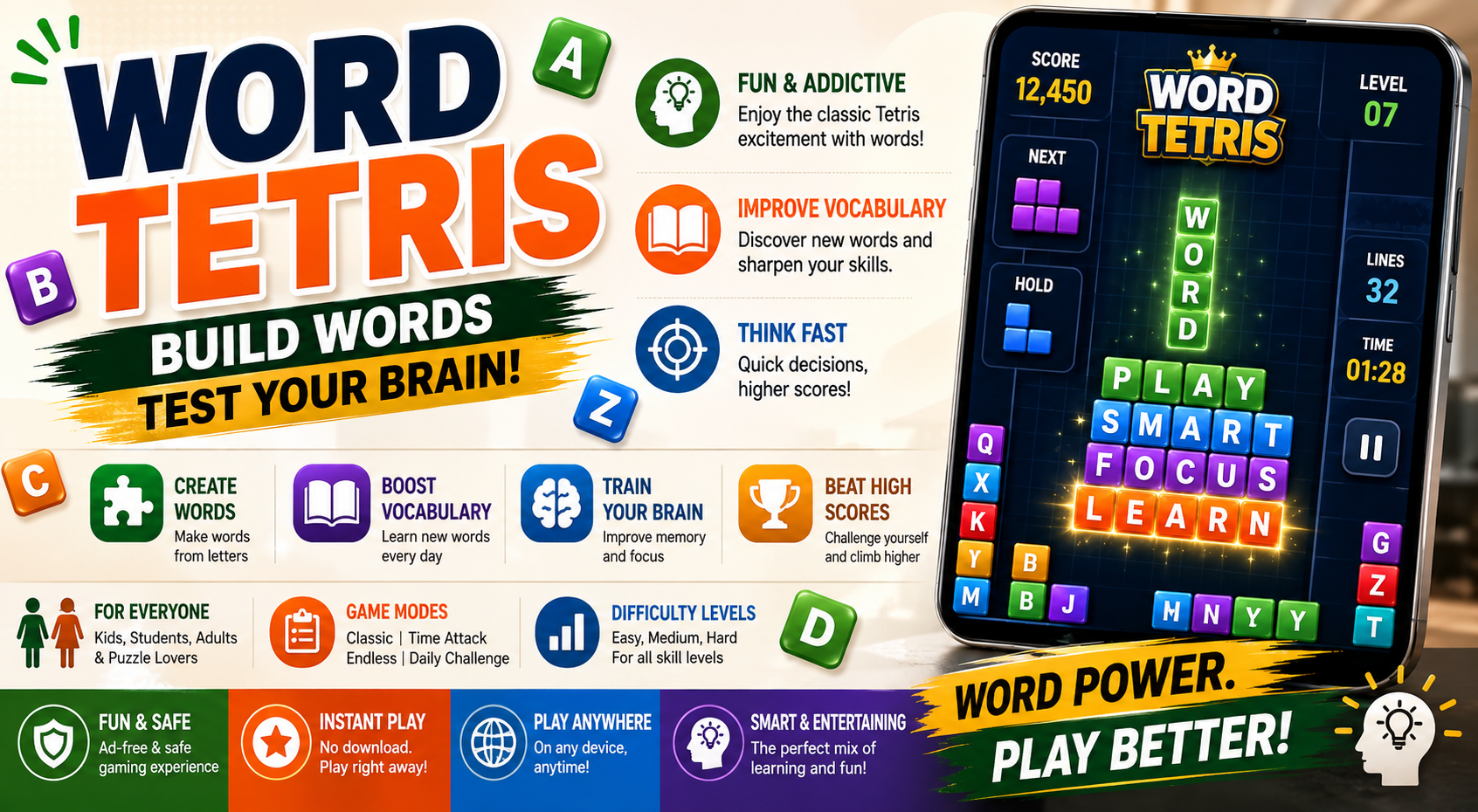
Word Tetris turns the classic falling block game into a fun word challenge. Players match letters, create words, and make quick choices to keep playing. Available on FreeWWW, this browser-based game helps improve vocabulary while offering fast and exciting puzzle gameplay with no download needed.

PLAY WORD TETRIS ONLINE
Open the free Word Tetris game on FreeWWW
A Word Game with Movement, Pressure, and Strategy
Many word games give you a fixed group of letters and unlimited time to think. Word Tetris changes that rhythm. Letters arrive as part of a moving puzzle, so the player must notice useful combinations before the board becomes difficult to manage. A short word may protect valuable space, while waiting for a longer word may offer a better scoring opportunity but create more risk.
That balance makes the game more than a spelling exercise. Each round asks you to read the board, make a plan, adapt when new letters appear, and decide whether speed or accuracy matters most in that moment. Students can use it for informal vocabulary practice, while adults and puzzle fans can treat it as a quick mental challenge.
How to Play Word Tetris Online

- Open the game. Launch Word Tetris in your browser through FreeWWW. The game is presented as instant play, so there is no software download to manage.
- Choose a mode and difficulty. The current game presentation includes Classic, Time Attack, Endless, and Daily Challenge modes, with Easy, Medium, and Hard difficulty options.
- Read the incoming letters. Watch the board and the next available blocks. Scan for common letter combinations instead of focusing on one possible word.
- Build valid words. Use the available letter blocks to create words while keeping enough open space for the next moves.
- Balance speed and accuracy. Fast decisions can protect the board, but careless spelling or poor placement can make the next move harder.
- Challenge your previous result. Use the score, level, lines, and timer displays to measure progress and try a different strategy in the next round.
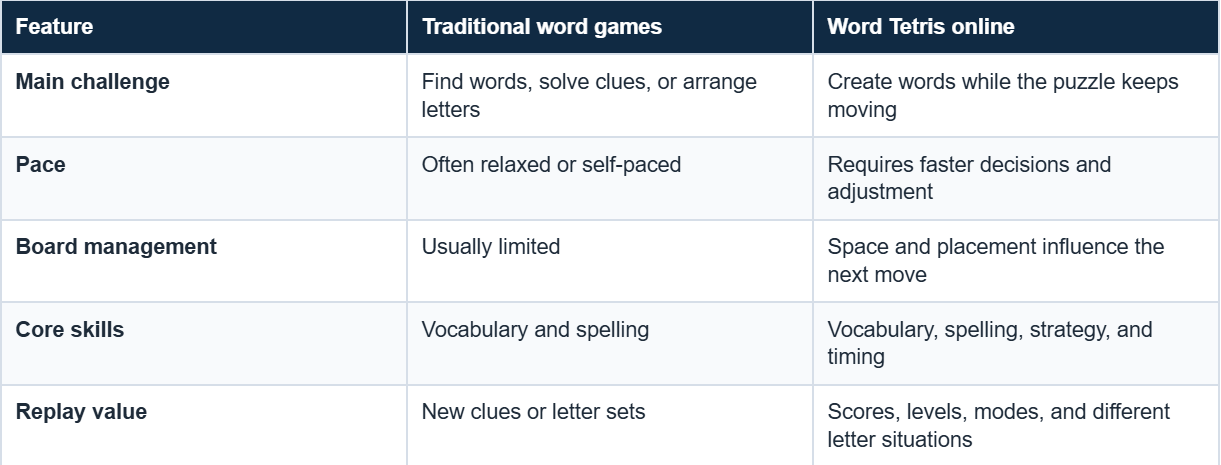
How Word Tetris Compares with Traditional Word Games
Unlike static clue or letter grid puzzles, Word Tetris adds movement, timing, board management, and scoring. The player is not only searching for a word; they are deciding when and where to use it.
Main Word Tetris Features
Falling letter gameplay
The moving blocks create urgency and make each board different. A plan that worked in the previous round may not fit the next set of letters.
Word-building challenge
Players combine letters into recognizable words, encouraging attention to spelling patterns and familiar word structures.
Multiple game modes
Classic, Time Attack, Endless, and Daily Challenge options provide different reasons to replay, from steady progression to time-focused competition.
Three difficulty levels
Easy, Medium, and Hard options allow players to select a challenge that matches their confidence and experience.
Progress indicators
The interface displays score, level, lines, and time, helping players understand how the round is developing.
Browser-based access
The game is presented as instant play with no download, making it easy to start from a compatible device.
Benefits of Playing Word Tetris Regularly
Repeated play can make common spelling patterns feel more familiar and encourage faster word recognition. The value comes from active practice: the player repeatedly scans letters, compares possible words, makes a choice, and sees the result. These benefits should be viewed as supportive practice rather than a replacement for reading, writing, classroom instruction, or formal language study.
Vocabulary awareness
Frequent exposure to letter combinations can remind players of known words and encourage them to notice unfamiliar ones.
Spelling practice
Building a word requires attention to letter order, which can reinforce spelling awareness through use rather than memorization alone.
Pattern recognition
Players learn to notice prefixes, suffixes, repeated endings, vowels, and other combinations that often appear in English words.
Flexible thinking
A promising word may become impossible when a new block arrives. Players must abandon one plan and quickly consider another.
Focused decision making
The moving board rewards attention. Looking too far ahead without managing the current space can create problems, while reacting too quickly can waste useful letters.
Who Can Enjoy the Online Word Tetris Game?
- Students: A lively way to reinforce spelling and vocabulary outside formal lessons.
- Language learners: Extra practice recognizing common English letter patterns and familiar words.
- Casual players: A quick browser game for a short break without complicated setup.
- Puzzle enthusiasts: A combination of word knowledge, placement decisions, speed, and score chasing.
- Parents and teachers: A supplemental activity that can make language practice feel less like a worksheet and more like play.
Practical Tips for Getting Better at Word Tetris
A common beginner mistake is waiting too long for a perfect word. Stronger play usually comes from keeping the board manageable while remaining ready to use better combinations when they appear.
Scan for short words first
Two-, three-, and four-letter possibilities can prevent the board from becoming crowded while you look for a longer option.
Notice common endings
Combinations such as -ing, -ed, -er, -ly, and -s can help turn a partial pattern into a valid word.
Protect open space
Avoid placements that create isolated gaps or leave useful letters trapped behind awkward blocks.
Use the next-block preview
When the interface shows the upcoming block, include it in your decision instead of reacting only to the current letters.
Learn from missed words
After a round, note any word you recognized too late. That word may become easier to spot the next time similar letters appear.
Increase difficulty gradually
Start at a comfortable level, build consistency, and move up when the pace no longer feels challenging.
Balance score and survival
A high-value word is useful only if waiting for it does not make the board impossible to manage.
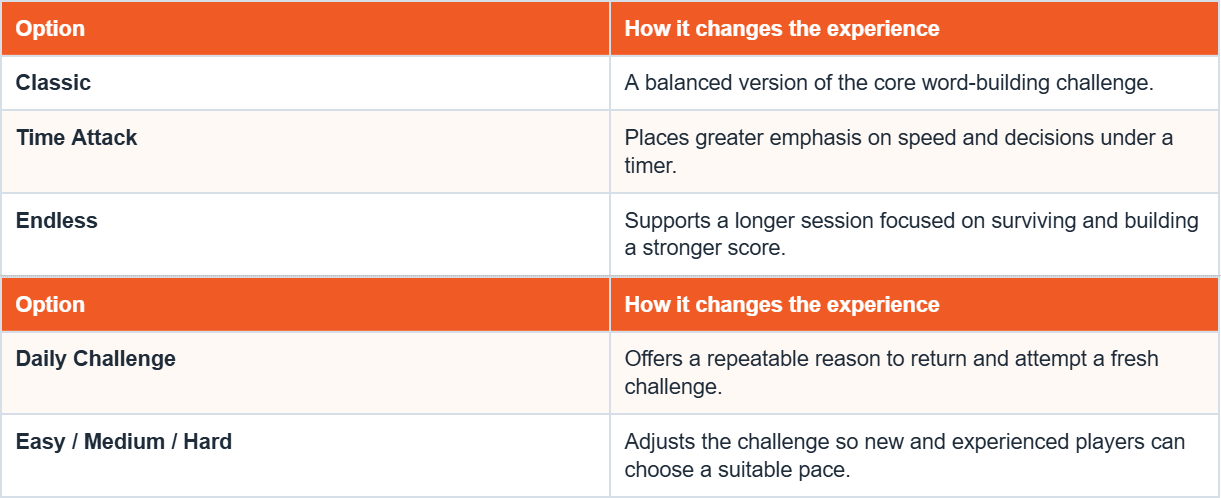
Game Modes and Difficulty Options
Different modes can change the purpose of a session. The promotional game interface presents the following options:
Word Tetris as an Educational Game
Educational games are most useful when the learning task is part of the action rather than added as a separate test. In Word Tetris, the player cannot progress without reading letters, recognizing patterns, and creating words. That makes vocabulary practice part of the gameplay itself.
The game can be useful as a warm-up, break activity, or optional practice tool. A teacher might use a short session to start a vocabulary discussion, while a learner might record unfamiliar words and review them later. It should still complement broader learning habits such as reading varied texts, writing regularly, checking definitions, and practicing words in context.
Why Play Word Tetris on FreeWWW?
FreeWWW brings browser-based tools and games together in one place. Word Tetris is designed for convenient access: open the page, begin playing, and return whenever you want another vocabulary challenge. Its combination of modes, difficulty levels, scoring, and colorful visual feedback makes it suitable for quick sessions as well as repeated practice.
- Free browser-based access
- No download required
- Modes for different play styles
- Difficulty choices for different skill levels
- Score and level tracking
- Suitable for students, adults, language learners, and puzzle fans
Conclusion
Word Tetris combines the familiar pressure of a falling-block puzzle with the satisfaction of finding the right word at the right moment. Players must recognize patterns, manage space, make quick decisions, and adapt as the board changes. That creates a game that is easy to understand but difficult to play the same way twice.
For students and language learners, it offers informal vocabulary and spelling practice. For casual players and puzzle fans, it offers speed, strategy, modes, difficulty levels, and a score to beat. Open the game in your browser and see how many useful words you can find before the blocks take control of the board.
Ready to build words and challenge your best score?
Play Word Tetris free on FreeWWW
Frequently Asked Questions
1. What is Word Tetris?
Answer: Word Tetris is an online word puzzle game that combines falling letter blocks with vocabulary challenges. Players form valid words while managing speed, space, and the changing board.
2. Is Word Tetris free to play?
Answer: Yes. The game is available free through FreeWWW as a browser-based experience.
3. How do I play Word Tetris online?
Answer: Open the game, choose an available mode and difficulty, watch the incoming letters, and create valid words before the board becomes too crowded.
4. Does Word Tetris require a download?
Answer: The game is presented as instant browser play, so no separate download is required.
5. What game modes are available?
Answer: The current game presentation includes Classic, Time Attack, Endless, and Daily Challenge modes.
6. Does Word Tetris have difficulty levels?
Answer: Yes. The game presentation includes Easy, Medium, and Hard difficulty options for different skill levels.
7. Can Word Tetris help improve vocabulary?
Answer: Regular play can provide extra exposure to letter combinations, spelling patterns, and familiar words. It works best as a supplement to reading, writing, and structured language learning. For more vocabulary practice, explore the British Council Vocabulary Games.
8. Is Word Tetris suitable for students and language learners?
Answer: Yes. It can be used as informal spelling and vocabulary practice, although it should not replace formal instruction.
9. How is Word Tetris different from classic falling-block games?
Answer: It uses word-based challenges rather than focusing only on arranging geometric shapes. Vocabulary, spelling, and word recognition become part of the placement strategy. To learn about the original falling-block game and its history, visit the official Tetris About page.
10. Where can I find more free online tools and games?
Answer: Visit FreeWWW to explore browser-based games, educational resources, productivity tools, calculators, and other free utilities.