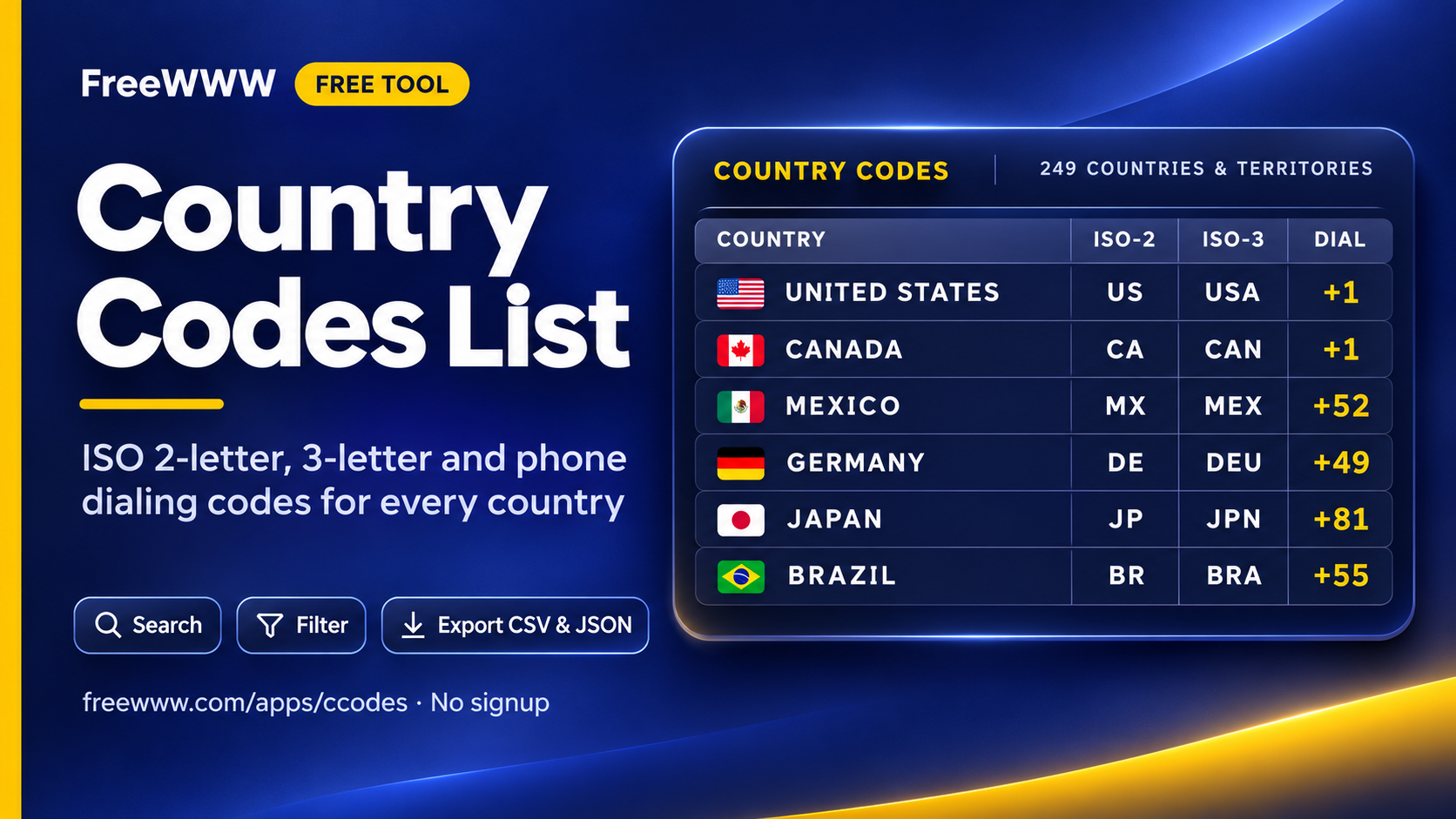
Country Codes List: ISO and Dialing Codes for Every Country
A country codes list matches every country to its standard IDs: a 2-letter ISO code (US), a 3-letter ISO code (USA), a 3-digit numeric code (840) and a phone dialing code (+1). The free FreeWWW Country Codes Lookup shows all four side by side, searches by name, code or phone prefix, and exports the full list with no signup.
Below you'll learn which code goes where, how to export a clean list for a spreadsheet or app, how US territories and the +1 code trip people up, and how to dial out of the US without a failed call.
What's in this guide:
1. The four types of country codes explained
2. How to look up a country code in seconds
3. How to export the full ISO country codes list
4. US territories: the country-or-state problem
5. Shared phone codes: +1 is not just the US
6. How to dial international numbers from the US
7. Common country code mistakes to avoid
8. Checklist before you use a country code
9. Frequently asked questions
The Four Types of Country Codes Explained
Every country has up to four standard codes: alpha-2, alpha-3, numeric and a phone dialing code. The first three come from the ISO 3166 standard; the phone code comes from the International Telecommunication Union's E.164 country code list, so the two systems don't line up.
ISO 3166-1 assigns codes to 249 countries, territories and special areas. That is far more than the 193 UN member states, because places like Puerto Rico, Guam and Greenland get codes of their own.
• 2-letter code (alpha-2): US for the United States, CA for Canada, MX for Mexico. Set by ISO 3166-1. You'll see it in checkout forms, payment and shipping APIs, and web domains (.us, .ca, .mx).
• 3-letter code (alpha-3): USA, CAN, MEX. Set by ISO 3166-1. You'll see it on passports, in government and UN datasets, and in reports where people read the code.
• Numeric code: 840, 124, 484. Set by ISO 3166-1, based on the UN M49 standard. You'll see it in statistics and banking systems that avoid letters.
• Dialing code: +1 for the US and Canada, +52 for Mexico. Set by the ITU (standard E.164). You'll see it in phone numbers, SMS logins and CRM contact fields.
Codes don't always match the English name. Germany is DE because the code follows its native name, Deutschland. Sports codes are a separate system too: Germany is GER at the Olympics but DEU in ISO data, and Switzerland is SUI versus CHE.
Want more than codes? The free FreeWWW Country Explorer shows each country's capital, currency and flag.
How to Look Up a Country Code in Seconds
Type a country name, a code or a phone prefix into the FreeWWW Country Codes Lookup, and the matching row shows every code at once. It runs in your browser, with no account and no email required.
1. Open the Country Codes Lookup.
2. Type a country ("Mexico"), an ISO code ("MX" or "MEX") or a phone code ("52").
3. Read the row: country, 2-letter code, 3-letter code and phone code.
4. Switch between Table, Cards and List views, whichever reads best on your screen.
5. Star the countries you use often so they stay pinned under Favorites.
6. Sort by name or by any code, ascending or descending.
[IMAGE: Search box with "52" typed and the Mexico row highlighted. Alt text: "Searching a phone prefix to find the country in a country code lookup"]
Identify an unknown international caller
Paste the first digits of a missed call into the search box to see which country it came from. This is the fastest way to tell a real overseas contact from a likely scam.
Scammers often call from Caribbean numbers that start with +1 and look like US area codes. The Federal Trade Commission warns about these "one ring" calls: you call back and get billed per minute for an international call. If the three digits after +1 aren't a US area code you recognize, look them up before you dial.
How to Export the Full ISO Country Codes List
Open the lookup, set any filters, click Export and choose CSV, JSON or Text. You get the complete table as a file in a few seconds, ready for a spreadsheet, a database or code.
• CSV for Excel, Google Sheets and bulk imports into Shopify, a CRM or a shipping tool.
• JSON for developers building a country dropdown or validating API input.
• Text for pasting into documentation, tickets or email.
Two habits keep the data clean. Store the alpha-2 code in your database and show the country name only in the interface, because names change and the code stays stable. And store phone numbers in E.164 format, such as +13125550147, so SMS and calling services accept them without reformatting.
Validating a phone field in your own form? Grab a tested pattern from the free FreeWWW Regex Pattern Dictionary.
US Territories: The Country-or-State Problem
Puerto Rico, Guam, the US Virgin Islands, American Samoa and the Northern Mariana Islands each have their own ISO country code, yet USPS treats them as US states in domestic addresses. That double identity is behind many failed checkouts and shipping errors for US businesses.
• Puerto Rico: ISO codes PR and PRI, USPS state code PR, phone +1 787 or +1 939.
• Guam: ISO codes GU and GUM, USPS state code GU, phone +1 671.
• US Virgin Islands: ISO codes VI and VIR, USPS state code VI, phone +1 340.
• American Samoa: ISO codes AS and ASM, USPS state code AS, phone +1 684.
• Northern Mariana Islands: ISO codes MP and MNP, USPS state code MP, phone +1 670.
Here is how it plays out. A customer in San Juan enters "United States" as the country and "PR" as the state, which is correct for USPS. A payment processor that compares the card's billing country (PR) with the order's country (US) may flag the mismatch and decline the order.
The fix is to decide one rule and apply it everywhere. Many stores accept both forms on input, then convert to whatever their carrier and payment provider expect. Check your providers' documentation for which one they want, and test an order to a territory before peak season.
Shared Phone Codes: +1 Is Not Just the US
The +1 code covers the United States, Canada and about 20 Caribbean countries and territories in the North American Numbering Plan (NANP). The three-digit area code after +1 tells you which one you're calling.
• +1: the US, Canada and Caribbean NANP members such as Jamaica (+1 876), the Bahamas (+1 242) and the Dominican Republic (+1 809, 829 and 849). The area code after +1 tells them apart.
• +7: Russia and Kazakhstan. Kazakhstan numbers start with +7 6 or +7 7.
• +39: Italy and Vatican City, told apart by the number range after +39.
• +44: the United Kingdom plus Guernsey, Jersey and the Isle of Man, told apart by the area code after +44.
Calls from the US to a Caribbean +1 number look domestic, but they are international calls and are billed as international. Mexico is not part of the NANP at all and uses +52. In the FreeWWW lookup, set the phone code filter to Shared codes to see every shared code at once.
How to Dial International Numbers from the US
From a US landline, dial 011, then the country code, then the number without its leading 0. From a cell phone, type + instead of 011, which also works when you travel.
• London, UK (written locally as 020 7946 0000): dial 011 44 20 7946 0000 from a US landline, or +44 20 7946 0000 from a cell phone.
• Berlin, Germany (030 1234567): dial 011 49 30 1234567, or +49 30 1234567.
• Mexico City (55 1234 5678): dial 011 52 55 1234 5678, or +52 55 1234 5678.
• Toronto, Canada ((416) 555-0123): dial 1 416 555 0123, or +1 416 555 0123.
• Kingston, Jamaica ((876) 555-0199): dial 1 876 555 0199, or +1 876 555 0199.
Notice the leading 0 disappears once a country code goes in front. The 0 is a domestic trunk prefix, and keeping it is the most common reason an overseas call fails.
Mexico simplified its dialing in 2019. Every number is now 10 digits after +52, and the old 044, 045 and extra "1" mobile prefixes are gone. Older guides that still show them will lead you to a wrong number.
When you give your own US number to someone abroad, write it as +1 312 555 0147. Don't add 011, which only works from the US, and don't add a second 1.
Before you dial, check the local time with the free FreeWWW Timezone Converter so your call doesn't land at 3 a.m.
Common Country Code Mistakes to Avoid
The mistakes that cost US teams the most are typing UK instead of GB, doubling the 1 in phone numbers, and handling US territories inconsistently. Each one leads to declined payments, rejected imports or calls that never connect.
• UK instead of GB. The ISO code for the United Kingdom is GB (GBR). UK is only reserved, though the web domain is .uk, and many payment and shipping APIs reject it.
• A doubled 1. +1 1 312… fails. When a form already supplies +1, enter only the 10-digit number.
• Keeping the trunk 0. +44 020… and +49 030… are wrong. Drop the 0 after the country code.
• Mixed code lengths. A column holding both "US" and "USA" breaks lookups and filters. Use one code type per field.
• Sports codes treated as ISO. GER, SUI and NED are Olympic or FIFA codes; ISO uses DEU, CHE and NLD.
• Stale lists. Names change even when codes don't: Swaziland is now Eswatini (still SZ) and Turkey is listed as Türkiye (still TR). Export a fresh list instead of copying one from an old project.
Checklist Before You Use a Country Code
• ☐ I know whether the field needs alpha-2, alpha-3, numeric or a dialing code.
• ☐ I used GB for the United Kingdom, not UK.
• ☐ Phone numbers are in +[code][number] format, with no doubled 1 and no trunk 0.
• ☐ For +1 numbers, I checked the area code to confirm the US, Canada or a Caribbean country.
• ☐ My forms and providers agree on how US territories are coded.
• ☐ I exported a current list rather than reusing an old copy.
Frequently Asked Questions
What is the country code for the United States?
The United States uses US as its 2-letter ISO code, USA as its 3-letter code and 840 as its numeric code. Its phone dialing code is +1, which it shares with Canada and many Caribbean countries, and its web domain is .us.
How do I call another country from the US?
From a landline, dial 011, then the country code, then the local number without its leading 0. From a cell phone, type + instead of 011, for example +44 20 7946 0000 for London.
Is the country code for the United Kingdom UK or GB?
The official ISO code is GB (GBR in the 3-letter form). UK is only a reserved code, even though the web domain is .uk and the phone code is +44.
Which countries use the +1 phone code?
The US, Canada and about 20 Caribbean countries and territories share +1 under the North American Numbering Plan. The three-digit area code after +1 shows the exact place, and calls to the Caribbean ones are billed as international. Mexico is not included; it uses +52.
Is Puerto Rico a country or a US state in forms?
It is both, depending on the system. Puerto Rico has its own ISO country code (PR, PRI), while USPS treats it as a state with the code PR. Check which form your shipping carrier and payment provider expect.
Can I download a list of all country codes for free?
Yes. The FreeWWW Country Codes Lookup exports the full list as CSV, JSON or plain text in one click, with no signup or payment.