Roman Numeral Converter: Convert Numbers Online Free
Roman numerals still appear on clocks, book chapters, movie titles, monuments, formal outlines, and historical documents. But converting a number such as 1984 into MCMLXXXIV can be surprisingly easy to get wrong.
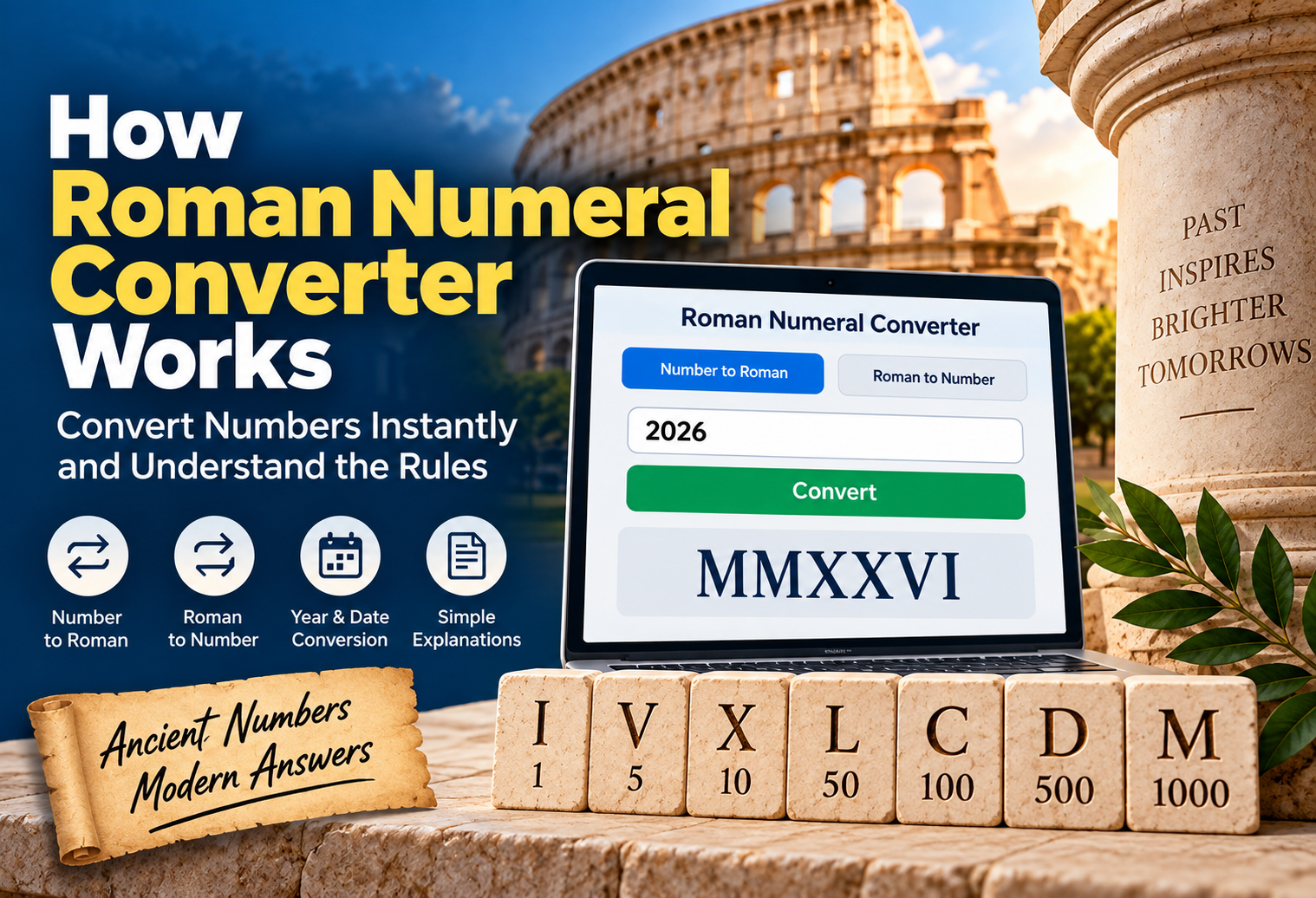
A roman numeral converter provides a quick way to translate ordinary numbers into Roman numerals and decode Roman numerals back into familiar decimal values. FreeWWW's tool supports conversion in both directions and also includes year and date conversion, validation, symbol breakdowns, and support for larger values using overline notation.
Try the Roman Numeral Converter
What Are Roman Numerals?
Roman numerals are a number system based on seven primary symbols:

The system uses combinations of these symbols to represent numbers. For example, VIII means 8 because V represents 5 and each I represents 1.
The basic system originated in ancient Rome and developed over time. Modern Roman numeral conventions are more standardized than the forms found in many historical documents, so an ancient inscription may not always follow the rules people learn today.
How Does a Roman Numeral Converter Work?
A roman numeral converter applies the standard relationships between symbols to produce a Roman numeral or interpret one.
- 4 = IV
- 9 = IX
- 14 = XIV
- 40 = XL
- 99 = XCIX
- 500 = D
- 2026 = MMXXVI
The process becomes easier when numbers are separated into thousands, hundreds, tens, and ones.
Take 1984: 1,000 + 900 + 80 + 4. That becomes M + CM + LXXX + IV = MCMLXXXIV.
The same principle works in reverse when decoding a Roman numeral into a decimal number.
The Most Important Roman Numeral Rule
Most modern Roman numeral conversions rely on two basic principles: addition and subtraction.
When a smaller or equal-value symbol follows a larger one, the values are generally added. VI = 5 + 1 = 6.
When a smaller symbol appears before a larger one in a recognized subtractive combination, the smaller value is subtracted. IV = 5 - 1 = 4.
Standard subtractive pairs

The National Archives also illustrates how Roman numerals can appear in both additive and subtractive forms in historical documents, which is useful when reading older material.
Why Some Roman Numerals Look Wrong
One of the most common mistakes is assuming that any smaller symbol can be placed before any larger symbol.
For example, IL is sometimes incorrectly used for 49. Under modern standard notation, 49 is XLIX, not IL. Similarly, IC is not the standard representation of 99. The correct form is XCIX.
A good roman numeral converter should therefore do more than simply assign values to letters. It should recognize valid notation and flag malformed combinations.
FreeWWW's tool provides live validation and identifies invalid forms such as IIII or VV. It also provides a symbol-by-symbol breakdown so users can see how the result was constructed.
Convert Years and Dates Into Roman Numerals
Roman numerals are frequently used for years, particularly in movie credits, monuments, building inscriptions, book titles, and other formal contexts.
For example: 2026 = MMXXVI.
A date can be more complicated because the day, month, and year each need to be converted separately.
A dedicated roman numeral converter with year and date functionality can save time when you need a specific date rather than a single number. The FreeWWW tool includes separate year and full-date conversion features.
This is particularly useful for designers, students, writers, and anyone working with historical or decorative numbering.
When Should You Use a Roman Numeral Converter?
Manual conversion is useful for learning, but an online tool becomes practical when accuracy and speed matter.
- Checking a Roman numeral in homework
- Converting historical dates
- Creating chapter or section numbers
- Reading Roman numerals on clocks
- Checking movie or event numbering
- Preparing educational materials
- Verifying a design before publication
- Understanding Roman numerals found on monuments
For repeated conversions, an online tool can also help you compare patterns and understand how different values are constructed.
A Quick Way to Check Roman Numerals
If you are unsure about a numeral, start with the seven basic symbols and identify any subtractive pairs.
For example, consider MCMXLIV. Break it apart: M + CM + XL + IV. Then calculate: 1,000 + 900 + 40 + 4 = 1,944.
This approach makes unfamiliar numerals much easier to understand.
For larger values, conventions can become more complicated. The FreeWWW converter supports numbers beyond the traditional 1 to 3,999 range through vinculum notation, where an overline multiplies a numeral by 1,000.
Make Roman Numeral Conversion Simpler
Roman numerals are not difficult once the seven symbols and subtractive pairs are familiar. The challenge is usually remembering the correct order and recognizing which combinations are considered standard.
A roman numeral converter removes that guesswork. Instead of manually checking every symbol, you can enter a number or numeral and verify the result immediately.
For students, researchers, writers, and anyone working with dates or traditional numbering, that makes a simple historical number system much easier to use.
When you need a quick conversion, use the FreeWWW Roman Numeral Converter to convert numbers, check Roman numerals, and explore how each result is constructed.
Use FreeWWW's Roman Numeral Converter for fast, clear, and accurate conversions.
Frequently Asked Questions
1. What is a Roman numeral converter?
Answer: A Roman numeral converter is an online tool that changes ordinary decimal numbers into Roman numerals and can also decode Roman numerals back into numbers.
2. What are the seven Roman numeral symbols?
Answer: The seven standard symbols are I for 1, V for 5, X for 10, L for 50, C for 100, D for 500, and M for 1,000.(Encyclopedia of Math)
3. How do you write 2026 in Roman numerals?
Answer: 2026 is written as MMXXVI. It can be separated into 2,000, 20, 5, and 1: MM + XX + V + I.
4. Why is 4 written as IV instead of IIII?
Answer: Modern standard notation generally represents 4 as IV using subtractive notation. Historical sources sometimes used IIII. Roman numeral examples from the UK National Archives
5. What are the subtractive pairs in Roman numerals?
Answer: The six standard subtractive pairs are IV, IX, XL, XC, CD, and CM. They represent 4, 9, 40, 90, 400, and 900.
6. What is the largest standard Roman numeral?
Answer: Under commonly taught standard notation without overlines, 3,999 is the largest value and is written MMMCMXCIX.
7. Can Roman numerals represent zero?
Answer: There is no standard Roman numeral symbol for zero.
8. Can I convert a Roman numeral back to a number?
Answer: Yes. A two-way converter can decode a valid Roman numeral into its decimal equivalent. MCMXLIV equals 1,944.
9. Are Roman numerals still used today?
Answer: Yes. Roman numerals remain visible in book chapters, clock faces, dates, formal numbering, and decorative applications.
10. Can a Roman numeral converter convert dates?
Answer: Some converters support date and year conversion. FreeWWW's tool includes dedicated year and full-date conversion features.