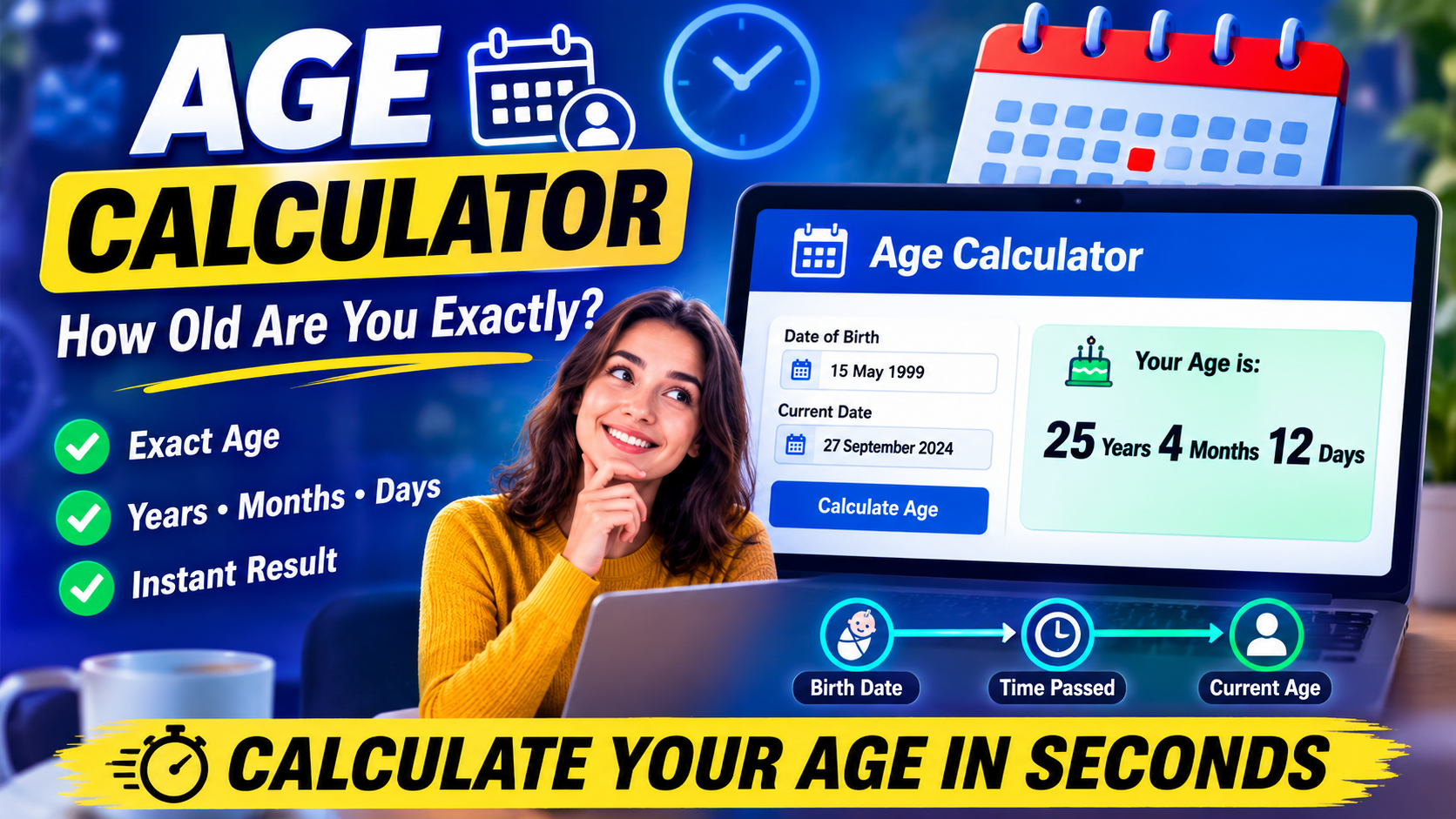
Want to Know Your Exact Age? Try This Age Calculator

Introduction
Calculating your age is easy when you only count birthdays, but finding your exact age in years, months, and days requires accurate calendar calculations. Different month lengths, leap years, and whether your birthday has already occurred can all change the final result.
That matters in everyday situations. A student may need to confirm an age requirement, a parent may want a child's exact age for a form, or an HR team may need a date-based check rather than a rough subtraction of birth years. An online Age Calculator handles the calendar work automatically.
Ready to calculate your exact age?
What Is an Age Calculator?
Instead of manually counting birthdays and calendar days, an age calculator compares your birth date with a selected date and instantly shows your completed years, months, and days. On FreeWWW's Date Calculator & Converter, the Age Calculator accepts a birth date and an 'as of' date so you can calculate age today or on another selected date.
How Does an Age Calculator Work?
The calculation begins with two dates: the date of birth and the date you want to calculate against. The tool measures complete calendar years first, then complete months, then the remaining days. This calendar based approach is more reliable than subtracting birth years alone.
- Compare the birth year with the selected year.
- Check whether the birthday has already occurred in the selected year.
- Count completed months after the last completed birthday.
- Calculate the remaining calendar days.
- Apply the correct month lengths and leap-year rules.
How to Calculate Your Age From Date of Birth

- Enter your date of birth.
- Select today's date or another date in the 'Calculate Age As Of' field.
- Run the Age Calculator.
- Review the exact result in years, months, and days
Example of Exact Age Calculation
Suppose someone was born on March 15, 2000, and checks their age on June 10, 2026. The complete calendar difference is 26 years, 2 months, and 26 days. A simple subtraction of 2026 - 2000 only gives the year count; it does not show the additional completed months and days.
Why Simple Year Subtraction Can Be Wrong
Imagine someone born in December 2005 checking their age in June 2026. Subtracting the years gives 21, but their December birthday has not happened yet, so they are still 20. An exact age calculator checks the full date before deciding how many complete years have passed.
Age Calculation Edge Cases
Birthday has not happened yet
If the selected date falls before your birthday in that calendar year, the calculator should not count the next year of age as completed.
Leap day birthdays
People born on February 29 still age normally, but calendar calculations must account for leap years and the absence of February 29 in most years. For legal or eligibility purposes, follow the rule used by the relevant organization or jurisdiction rather than relying on a general calculator alone.
End-of-month dates
Dates near the end of a month can make manual month and day counting confusing because months contain different numbers of days. A calendar-based calculator handles those differences automatically.
International date formats
A date such as 03/04/2000 can mean March 4 or April 3 depending on the country and format. Use the date picker or confirm the day, month, and year before calculating so the input is unambiguous.
Why Leap Years Matter in Age Calculation
The Gregorian calendar normally has 365 days, while leap years contain 366 days because February includes an extra day. NIST explains that most years divisible by four are leap years, except century years unless they are also divisible by 400. Accurate age calculations need to respect these calendar rules when dates cross February 29.
Age Calculator for Different Purposes
- School or program eligibility: Check whether a person meets a stated age requirement on a particular date.
- Forms and records: Provide a more precise date-based age when a form requests exact age information.
- HR and administration: Confirm age on a selected date without manually counting birthdays.
- Family milestones: Track children's ages, birthdays, anniversaries, and other date-based milestones.
- Research and data work: Organize age information consistently when working with dates of birth.
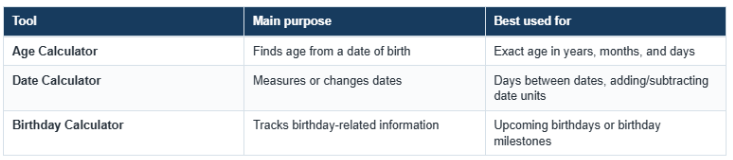
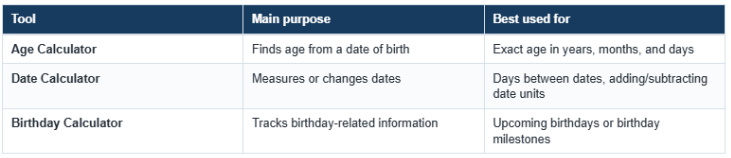
Age Calculator vs Date Calculator vs Birthday Calculator
Chronological Age vs Biological Age
Chronological age is the amount of calendar time that has passed since a person's birth date. Biological age is a separate health concept that tries to describe how the body's condition compares with typical aging patterns. An Age Calculator measures chronological age only; it does not estimate biological age or health status.
How Accurate Is an Online Age Calculator?
For ordinary calendar calculations, an age calculator can provide a precise chronological age when the birth date and comparison date are entered correctly. The main sources of error are usually incorrect input, ambiguous date formats, or using a general calculator for a legal rule that has its own definition of age.

Related FreeWWW Date Tools
For general date differences, countdowns, date formatting, and age calculations, use the FreeWWW Date Calculator & Converter.
For converting dates between calendar systems, use the FreeWWW Calendar Date Converter.
Conclusion
An Age Calculator is most useful when you need more than a rough year count. By comparing a complete date of birth with a selected date, it can show chronological age in years, months, and days while handling varying month lengths and leap years.
For everyday calculations, forms, eligibility checks, or personal milestones, accurate input is the key. When an organization has a specific legal or administrative definition of age, always follow that rule in addition to the calculator result.
Find your exact age in seconds
Frequently Asked Questions
1. What is an Age Calculator?
Answer: An Age Calculator compares a date of birth with today or another selected date and returns the completed chronological age, usually in years, months, and days.
2. How do I calculate my age from my date of birth?
Answer: Enter your birth date, choose the date you want to calculate against, and run the calculator. It measures the full calendar difference instead of only subtracting the two years.
3. What does an exact age calculator show?
Answer: An exact age calculator typically shows completed years, months, and days. Some tools may also provide additional date related information.
4. Why is my age different from simply subtracting the years?
Answer: Year subtraction can be one year too high when your birthday has not happened yet. Exact calculation checks the month and day as well as the year.
5. Can I calculate my age on a future or past date?
Answer: Yes. If the calculator allows an 'as of' date, you can compare your birth date with a selected past, present, or future date.
6. How do leap years affect age calculations?
Answer: Leap years add February 29, so accurate calendar calculations must use the correct number of days in each year and month. This is especially relevant for dates around late February.
7. What is a 'how old am I' calculator?
Answer: It is another name for an Age Calculator. It uses your date of birth to determine how many complete years, months, and days have passed.
8. What is the difference between chronological age and biological age?
Answer: Chronological age is the calendar time since birth. Biological age is a health-related concept about the body's condition. An Age Calculator measures chronological age only.
9. Can I use an Age Calculator for official documents?
Answer: It can help you calculate chronological age, but you should follow the exact rules of the organization requesting the information, especially for legal or eligibility purposes.
10. What should I do if a date format is confusing?
Answer: Use a date picker when available and verify the day, month, and year. Formats such as 03/04/2000 can be interpreted differently across countries.