Percent Decrease Calculator – Fast & Accurate
Introduction
Have you ever seen a price drop from $150 to $120 and wondered exactly how large the reduction was? You could work it out manually, but a percentage decrease calculator gives you the answer faster and helps prevent calculation errors.
I find this tool useful for discounts, business reports, investments, grades, budgets, and everyday comparisons. It works like a shortcut through the arithmetic, turning two values into a clear percentage within seconds.
Key Takeaways
What Is a Percent Decrease Calculator?
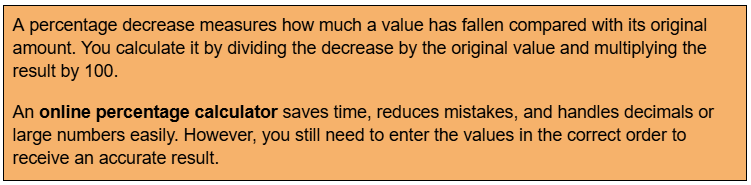
A percentage decrease calculator is a digital tool that measures the proportional reduction between an original value and a smaller new value. It tells you not only how much was lost but how important that loss is relative to the starting point.
For example, a decrease of 20 means different things depending on whether the original value was 40 or 400. The calculator adds context, much like a map adds meaning to a distance.
How to Use the Percent Decrease Calculator
Using a percentage calculation tool is simple. You enter the original value, add the new value, and select the calculation button to receive the percentage decrease.
Before calculating, confirm that the new value is smaller than the original. If it is higher, you are dealing with an increase rather than a decrease.
Enter the Original Value
The original value is the number before the reduction occurred. It could represent an old price, last month’s sales, an earlier test score, or an investment’s starting value.
Always place this number in the original value field. Reversing the numbers is like reading a journey backward; it changes the meaning of the result.
Enter the New Value
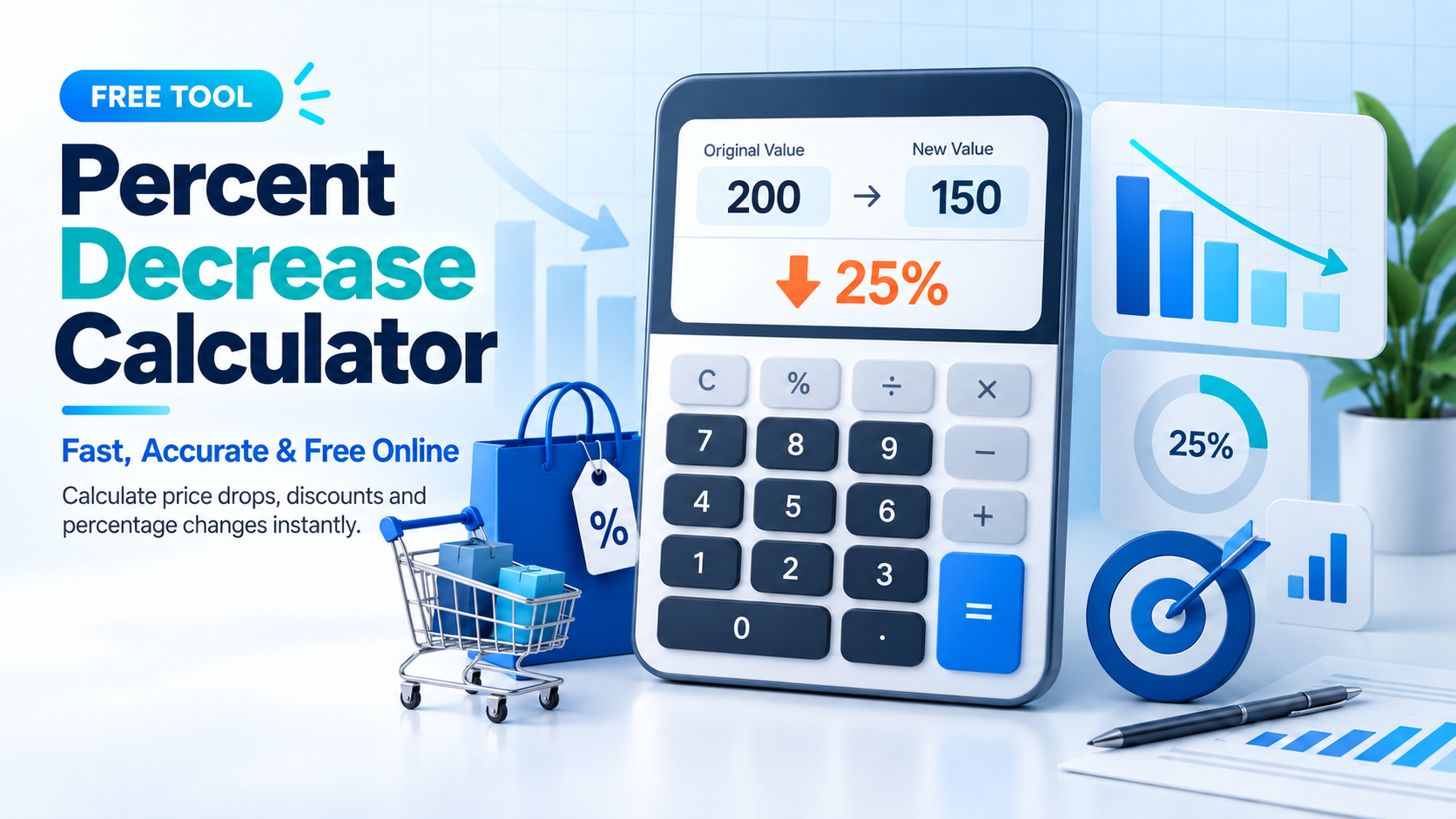
The new value represents the amount after the decrease. If a product originally cost $200 but now costs $150, your new value is $150.
Check the number before continuing, especially when working with decimals. A misplaced decimal point can turn a reasonable result into a wildly inaccurate one.
Calculate the Percentage Decrease
After entering both numbers, click the calculation button. The percentage decrease calculator subtracts the new value from the original, divides the difference by the original value, and converts the answer into a percentage.
You can also record the result in your percentage calculation history if the tool supports that feature. This makes comparing multiple calculations easier.
Percentage Decrease Formula
The standard percentage formula is:

The original value acts as the reference point. This is important because percentage decrease always describes the reduction in relation to where the value started.
Step-by-Step Percentage Decrease Calculation
First, subtract the new value from the original value. Next, divide that difference by the original value. Finally, multiply the result by 100.
Suppose a number decreases from 80 to 60. The difference is 20, and 20 divided by 80 equals 0.25. Multiplying 0.25 by 100 gives a 25% decrease.
Percentage Decrease Calculation Example
Imagine that a jacket originally costs $120 and is reduced to $90. The amount of the decrease is $30.
Divide 30 by 120 to get 0.25, then multiply it by 100. The jacket has decreased in price by 25%, and its final price after discount is $90.
How to Calculate Percentage Decrease

Manual calculation is useful for understanding the process. A calculator becomes more helpful when you need speed, precision, or several results at once.
Calculating a Price Reduction
To measure a price reduction, use the regular percentage-decrease formula. A discount calculator may also show the amount saved and the final sale price.
For example, if an item drops from $250 to $200, the reduction is $50. Dividing 50 by 250 and multiplying by 100 produces a 20% decrease.
Calculating a Decrease in Sales
Businesses can compare revenue, orders, leads, or website traffic across two periods. If monthly sales fall from $50,000 to $42,500, the decrease is $7,500.
Divide $7,500 by $50,000 and multiply by 100. The result is a 15% decrease, giving the business a clearer view of its performance.
Calculating a Drop in Grades or Scores
A grade percentage calculator can measure an individual score, while the decrease formula compares an earlier grade with a newer one. These are related but different calculations.
If a score falls from 90 to 72, the reduction is 18. Dividing 18 by 90 gives 0.20, so the score decreased by 20%.
Percent Decrease vs. Percent Increase
A decrease measures how far a value has fallen, while an increase measures how far it has risen. A percentage increase calculator uses the original value as its reference but adds growth instead of measuring loss.
The formulas look similar because both calculate change relative to the starting amount. The direction of the change determines whether the answer represents an increase or decrease.
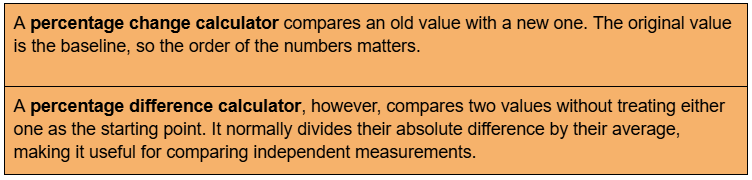
Percentage Change vs. Percentage Difference
Common Uses of a Percentage Decrease Calculator
A percentage decrease appears anywhere values can fall. You may use it for product prices, monthly expenses, sales figures, investment values, grades, weight, or energy consumption.
I like using the calculator whenever the size of a reduction is more meaningful than the raw difference. Saying “sales fell by 18%” usually communicates more than saying “sales fell by 900 units.”
Discounts and Sale Prices
Retail discounts are among the most common uses. An original price calculator can help you work backward, while a decrease calculator confirms the percentage saved.
This is especially useful when stores display a new price without clearly stating the discount. You can compare offers and determine which deal provides better value.
Business Revenue and Expenses
Business owners can measure falling revenue, costs, conversion rates, or customer numbers. A clear percentage makes performance easier to compare across periods of different sizes.
A reduction is not always negative. A 12% decrease in operating expenses may show that a cost-saving strategy is working.
Investment and Financial Losses
Investors use percentage decreases to measure declines in stocks, funds, or portfolio values. The percentage shows the scale of the loss relative to the starting investment.
Remember that recovering from a loss may require a larger percentage increase. After a 50% fall, for instance, a value must increase by 100% to return to its starting point.
Academic Grades and Test Scores
Students and teachers can compare changing scores over time. An exam score percentage measures points earned, while percentage decrease measures how much a score has fallen.
This distinction matters. Scoring 80% on an exam is not the same as experiencing an 80% decrease from a previous score.
Benefits of Using an Online Percentage Calculator
An online percentage calculator gives you quick results without requiring spreadsheets or memorized formulas. It is particularly useful for long decimals and repeated calculations.
Many tools can also add or subtract percentage, find the percentage of a number, or perform reverse calculations. This creates one convenient workspace for several everyday math problems.
Common Percentage Decrease Mistakes
The most common mistake is dividing by the new value instead of the original value. Percentage decrease must use the original amount as its baseline.
People also confuse percentage decrease with percentage points. A rate dropping from 40% to 30% falls by 10 percentage points, but its relative percentage decrease is 25%.
Calculate Percentage Decrease Online for Free
A free calculator lets you enter two values and obtain a result immediately. There is no need to build formulas, perform long division, or risk rounding too early.
You can use the FreeWWW Percentage Calculator for percentage decreases and several related calculations. For additional learning, explore Khan Academy’s percentage lessons and BYJU’S percentage guide.
Conclusion
A percentage decrease calculator turns a potentially confusing calculation into a quick, understandable result. Enter the original value and new value, and the tool measures the reduction relative to where you started.
Whether you are checking a discount, reviewing business performance, tracking an investment, or comparing grades, the same formula applies. Use the calculator for speed, but remember the simple logic behind it: find the drop, compare it with the beginning, and multiply by 100.
Calculate Your Percentage for Free
Frequently Asked Questions
1. Can a Percentage Decrease Be More Than 100%?
Answer: A normal decrease cannot exceed 100% when the new value remains zero or positive. A 100% decrease means the value has fallen completely to zero.
A result above 100% may appear when the new value becomes negative. In most everyday situations, such a result signals that you should check the values and context.
2. How Do I Find the Original Value?
Answer: To find the original number after a known percentage decrease, divide the final value by one minus the decrease rate written as a decimal.
For example, if $80 remains after a 20% decrease, divide 80 by 0.80. A reverse percentage calculator will show that the original value was $100.
3. How Do I Calculate a 20% Decrease?
Answer: Multiply the original value by 20% to find the reduction. Then subtract that amount from the original number.
You can also multiply the original value directly by 0.80. For example, a 20% decrease from 150 produces a new value of 120.
4. Is Percentage Decrease the Same as Percentage Change?
Answer: Percentage decrease is one type of percentage change. It specifically describes a movement from a larger original value to a smaller new value.
The phrase calculate percent change may refer to either an increase or decrease. The direction depends on whether the new value is above or below the original.
5. How Do I Calculate the Percentage of a Number?
Answer: Convert the percentage into a decimal and multiply it by the number. To calculate 15% of 200, multiply 0.15 by 200 to get 30.
An online calculator can handle this separately from percentage decrease. This calculation finds a portion of a value rather than measuring change between two values.
6. How Do I Convert a Fraction into a Percentage?
Answer: Use a fraction to percentage converter or divide the numerator by the denominator and multiply by 100. For example, 3 ÷ 4 × 100 equals 75%.
To reverse the process, a percentage to fraction converter changes a percentage into a fraction and simplifies it when possible.
7. Can I Use the Calculator to Work Out Tips?
Answer: Yes, a tip calculator finds a selected percentage of a bill and adds it to the total. Some tools can also divide the amount among several people.
A bill splitting calculator is useful when diners want to divide the bill and tip equally without handling the arithmetic manually.
8. Why Are Percentages Increase and Decrease Not Reversible?
Answer: They use different starting values. If $100 decreases by 20%, it becomes $80, but increasing $80 by 20% produces only $96.
To return from $80 to $100, you need a 25% increase. This is why percent increase and decrease calculations must always use the correct baseline.
9. Should I Round the Numbers Before Calculating?
Answer: Keep as many decimal places as possible during the calculation and round only the final result. Early rounding can introduce small errors.
This matters when working with money, scientific measurements, or large datasets. A good calculator maintains precision automatically.
10. Can I Use the Tool on a Mobile Device?
Answer: Yes, a browser-based calculator can usually be used on a smartphone, tablet, laptop, or desktop computer. You only need an internet browser to access it.
This makes it convenient while shopping, studying, reviewing reports, or making quick financial comparisons away from your desk.